
By Philippe, regulatory expert at Optima AI · Updated November 10, 2026
The CE marking of a machine is the marking by which the manufacturer indicates that his machine complies with the European requirements applicable to it. No one issues it: the manufacturer himself applies it, in the final stage, after assessing the risks, compiling the technical documentation, applying the conformity assessment procedure foreseen for his machine and signing the declaration of conformity («CE» under Directive 2006/42/EC until January 19, 2027, «EU» under Regulation 2023/1230 thereafter). A quasi-machine, however, does not bear the CE marking under the machinery regulation: it is delivered with a EU declaration of incorporation and an assembly instruction manual.
In short
- Until January 19, 2027, the CE marking of machines is governed by Directive 2006/42/EC. From January 20, 2027, it is governed by Regulation (EU) 2023/1230, which repeals the directive on that date (Article 51).
- The CE marking comes at the end of a process set out in Article 10 of the regulation: risk assessment, technical documentation, conformity assessment procedure, EU declaration of conformity, Then marking.
- For most machines, the manufacturer performs the procedure alone (internal production control, module A). One Notified body It only intervenes for certain categories listed in Annex I.
What is the CE marking of a machine?
Regulation (EU) 2023/1230 defines it as follows: the CE marking is «the marking by which the manufacturer indicates that the machine or a related product complies with the applicable requirements set out in the Union harmonisation legislation providing for its affixing» (Article 3, point 25).
It is not a quality label: it says that health and safety requirements have been met, not that the machine is performing well.
Directive 2006/42/CE or Regulation 2023/1230: which text applies?
This depends on the date of placing on the market or putting into service. Until January 19, 2027, This is Directive 2006/42/EC, whose Article 5 sets out the same steps with a «CE declaration of conformity». Starting from January 20, 2027, This is the regulation (EU) 2023/1230 (article 54): the declaration becomes «EU», and the notice can be provided in digital format.
For details of the new features, see our webinar Machine Regulations 2023/1230: What changes on January 20, 2027.
Who must affix the CE marking on a machine?
The manufacturer. In the sense of the regulation, it is the company that manufactures the machine, or has it designed or manufactured, and markets it under its own name or brand; it is also the company that builds a machine and puts it into service for its own use (Article 3, point 18).
Two other situations bring this role into play:
- the integrator which assembles machines or quasi-machines «arranged and controlled in such a way as to be interdependent in their functioning»: the whole is a machine (Article 3, point 1, d);
- from January 20, 2027, the author of a substantial modification, This includes the operator who transforms a machine in his factory: he is considered the manufacturer of that machine (Article 18).
What are the steps involved in CE marking a machine?
The articles cited are those of the regulation; for a machine placed on the market before January 20, 2027, the same steps are carried out under Directive 2006/42/EC (article 5, procedures of article 12, technical dossier of Annex VII).
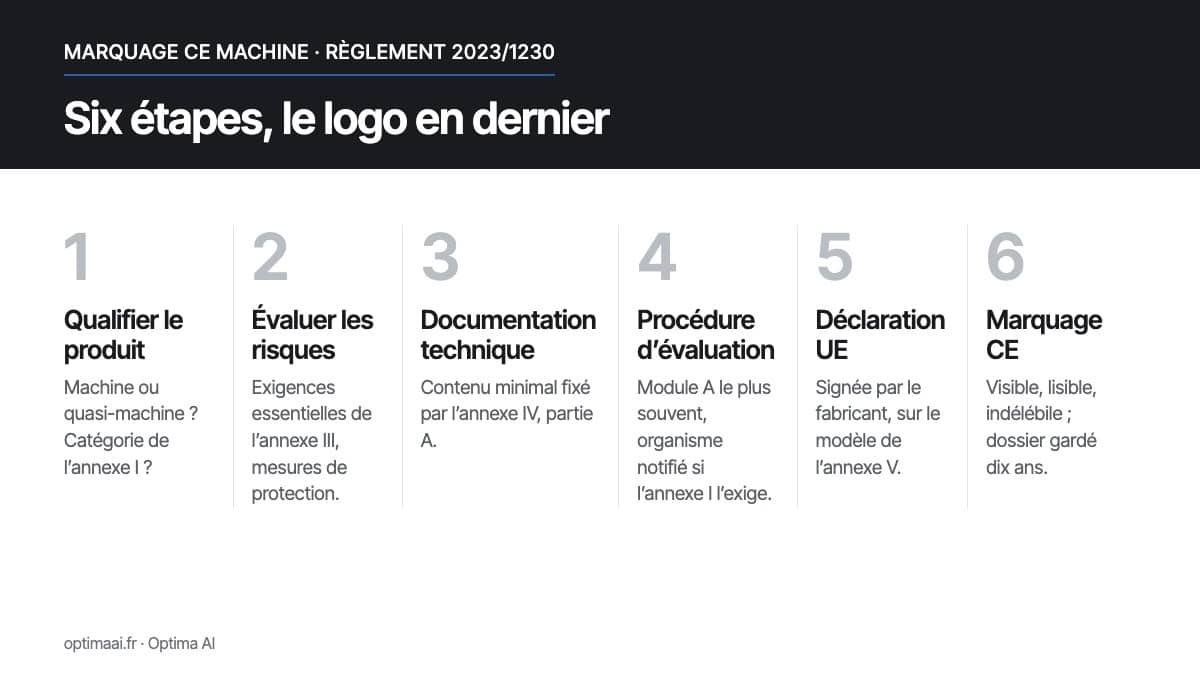
The regulation sets out the procedure in Article 10: the machine must be designed and manufactured in accordance with the essential health and safety requirements of Annex III; before placing a machine […] on the market or putting it into service, the manufacturer must establish the technical documentation and apply the conformity assessment procedure; once compliance is demonstrated, he must establish the EU declaration of conformity and affix the CE marking.
1. Qualify the product
Machine, quasi-machine, security component? Article 3 decides on everything else. A quasi-machine is «an assembly that does not yet constitute a machine, because it cannot ensure by itself a defined application» (Article 3, point 10). Also check Annex I: it sets out the procedure for step 4.
2. Assess the risks and design accordingly
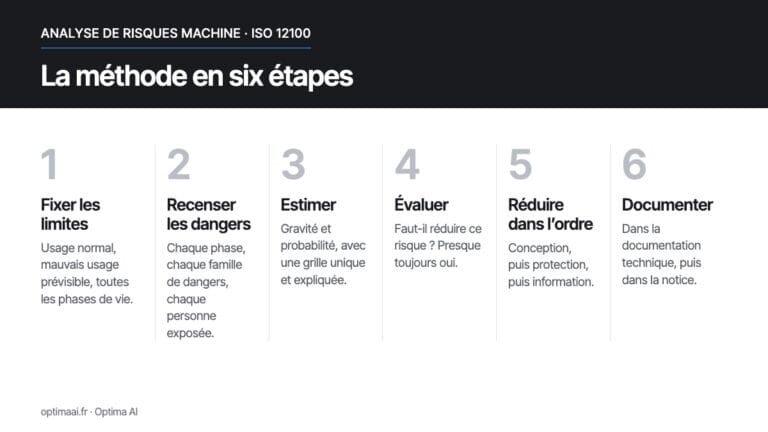
The essential health and safety requirements of Annex III are mandatory. To know which ones apply, the manufacturer assesses the risks: see our article Machine risk analysis according to ISO 12100. A machine constructed in accordance with a harmonized standard published in the Official Journal is presumed to meet the requirements covered by that standard (Article 20).
3. Create the technical documentation
Annex IV, Part A, sets out the minimum content thereof, which includes:
- the description of the machine and its normal use;
- the documentation on the risk assessment, including the protective measures and the residual risks;
- the drawings, diagrams, calculations and test reports;
- the harmonized standards applied, specifying the parts applied;
- a copy of the instructions;
- where applicable, the declarations of the quasi-machines and the incorporated products.
4. Apply the conformity assessment procedure
The choice depends on Annex I (Article 25):
| Your machine | Possible procedures | Notified body? |
|---|---|---|
| Absent from Annex I (the most common case) | Internal control of production, module A (Annex VI) | No |
| Annex I, Part B (chainsaws, hand-loading presses, people detection devices…), built in accordance with harmonized standards or common specifications covering all relevant requirements | Module A, or one of the procedures below | No with the A module |
| Annex I, Part B, without these standards or specifications covering all requirements | EU type examination (module B) followed by module C; full quality assurance (module H); unit verification (module G) | Yes |
| Annex I, Part A (removable mechanical transmission devices, lifting bridges for vehicles, portable machines for explosive load fixing and other shock machines, components and safety systems with self-evolving behavior…) | Module B followed by module C; module H; module G | Yes |
The identification number of the notified body follows the CE marking in the cases provided for in Article 24, paragraph 3: when conformity is assessed according to one of the procedures in Article 25, paragraph 2, points a), b) and c), or Article 25, paragraph 3, points b), c) and d), that is, all the procedures in the table except module A.
5. Establish and sign the EU Declaration of Conformity
The declaration «attest that compliance with the essential health and safety requirements set out in Annex III has been demonstrated» (Article 21). It follows the model of Annex V, Part A. By signing it, the manufacturer «assumes the responsibility for the conformity» of their machine. It accompanies the machine, or the notice provides the internet address or code to access it (Article 10, paragraph 8).
6. Place the CE marking and keep the file for ten years
The marking is affixed « in a visible, legible and indelible manner » on the machine, before it is placed on the market or put into service (Article 24). The machine also bears its designation, its serial number or type, its year of manufacture and a lot or serial number (Article 10, paragraph 5), the details of the manufacturer (Article 10, paragraph 6) and the other markings of Annex III, section 1.7.3. The instruction manual accompanies it (Article 10, paragraph 7). Finally, the technical documentation and the declaration are kept at the disposal of the authorities for at least ten years after the machine is placed on the market or put into service (Article 10, paragraph 3).
Should a quasi-machine bear the CE marking?
No, not under the machinery regulation. The rules for affixing the CE marking (article 24) apply to machines and related products; the quasi-machine follows a separate circuit, described in article 11. Its manufacturer, before placing it on the market:
- it is designed in accordance with the essential health and safety requirements relevant from Annex III;
- draws up its technical documentation in accordance with Annex IV, Part B;
- it is accompanied by an assembly instruction (Annex XI);
- establishes the EU incorporation declaration (article 22, model of Annex V, part B), which specifies which requirements are applied and fulfilled and that the quasi-machine «is not put into service until the final machine in which it is to be incorporated has been declared compliant».
For the full definition, see the fiche quasi-machine from our lexicon.
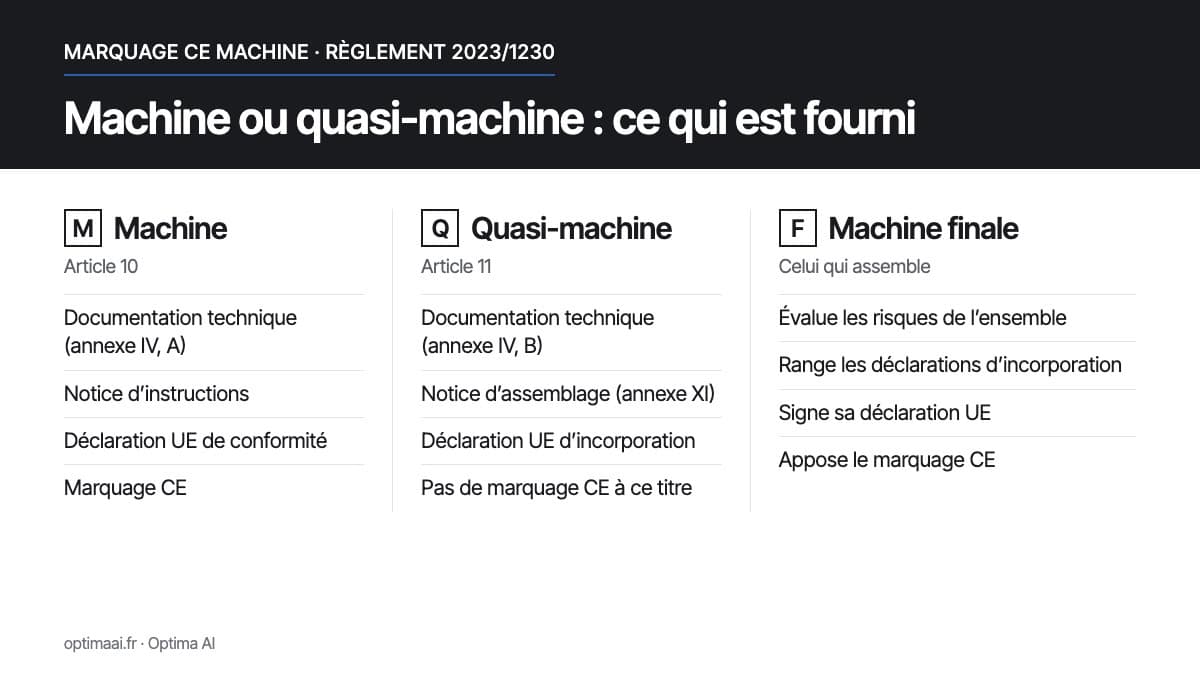
It is then the manufacturer of the final machine, often the integrator, who assesses the risks of the whole system, archives these documents in its technical documentation (Annex IV, Part A, point j), signs its EU declaration of conformity and places the CE marking.
Example: a palletizing cell built around a robot
Fictitious and simplified example: an integrator builds a cell for a client with a robot, a feed conveyor, an intangible barrier, and a common control cabinet.
- The robot Arrives without tools or protections: it cannot ensure the defined application alone. It is delivered as a quasi-machine, with its declaration of incorporation and assembly instructions. The integrator verifies the declared requirements «applied and fulfilled» and the conditions of incorporation.
- The intangible barrier, The device for detecting persons listed in Annex I, Part B, bears its own CE marking; its declaration is included in the documentation of the cell.
- The complete cell is a set of machines controlled in a coordinated manner (Article 3, point 1, d). The integrator is the manufacturer: it assesses the risks of the entire system (access to the robot area, interactions with the conveyor, maintenance), then follows the six steps for the cell.
Common mistakes
- Believing that the final machine is compliant because every element is compliant. CE-marked machines, assembled and ordered together, form a new machine, with new risks and a new manufacturer.
- Sign the declaration before you have finished the technical documentation. The declaration attests to an already made demonstration (Article 10).
Prepare the technical dossier without starting from scratch
Optima AI comes from the technical documentation of the machines and from their founder's expertise in CE compliance. Optima Compliance, Our offer for machine compliance starts with your own documents. Optima Doc Compilation It concerns the assembly of the technical dossier based on the supplier documents; it is under development, with no announced date. After a modification, Optima Doc Update, In a pilot version, with guidance, it provides an indicative opinion on its substantive nature, which you validate, and only rewrites the relevant sections of the notice. For the notice, Optima Doc Creation, In a pilot version, with support, draft a first draft in 14 structured sections according to EN ISO 20607, based on your functional analysis and your risk analysis; its Free trial It is done on one of your documents.
The tool prepares. Your expert revises, corrects and validates: the EU declaration of conformity remains under your signature.
Frequently asked questions
Is the CE marking mandatory for a machine?
Yes, for any machine that falls within the scope of the regulation (article 2 excludes certain ones), placed on the market or put into service in the European Union, including a machine built for its own use. It is affixed before placing on the market or putting into service (articles 10 and 24 of Regulation 2023/1230; article 5 of Directive 2006/42/EC until January 19, 2027).
Who issues the CE marking for a machine?
No one: the manufacturer applies it himself, under his responsibility. For certain categories of Annex I, a notified body intervenes in the procedure, but it is still the manufacturer who applies the marking and signs the EU declaration of conformity.
Should the CE marking of existing machines be re-applied in 2027?
No. A machine placed on the market under Directive 2006/42/EC before 20 January 2027 may continue to be made available (Article 52 of the Regulation). Only a substantial modification makes the manufacturer of the machine (Article 18).
Sources
- Regulation (EU) 2023/1230 on machinery, consolidated text of 27 July 2026 Articles 2, 3, 10, 11, 18, 20, 21, 22, 24, 25, 51, 52, 54; Annexes I, IV, V, VI (EUR-Lex)
- Directive 2006/42/CE on machinery Articles 5, 12 and 13, Annex VII (EUR-Lex)
- Machines: the regulations (General Directorate of Enterprises)
 French
 English