
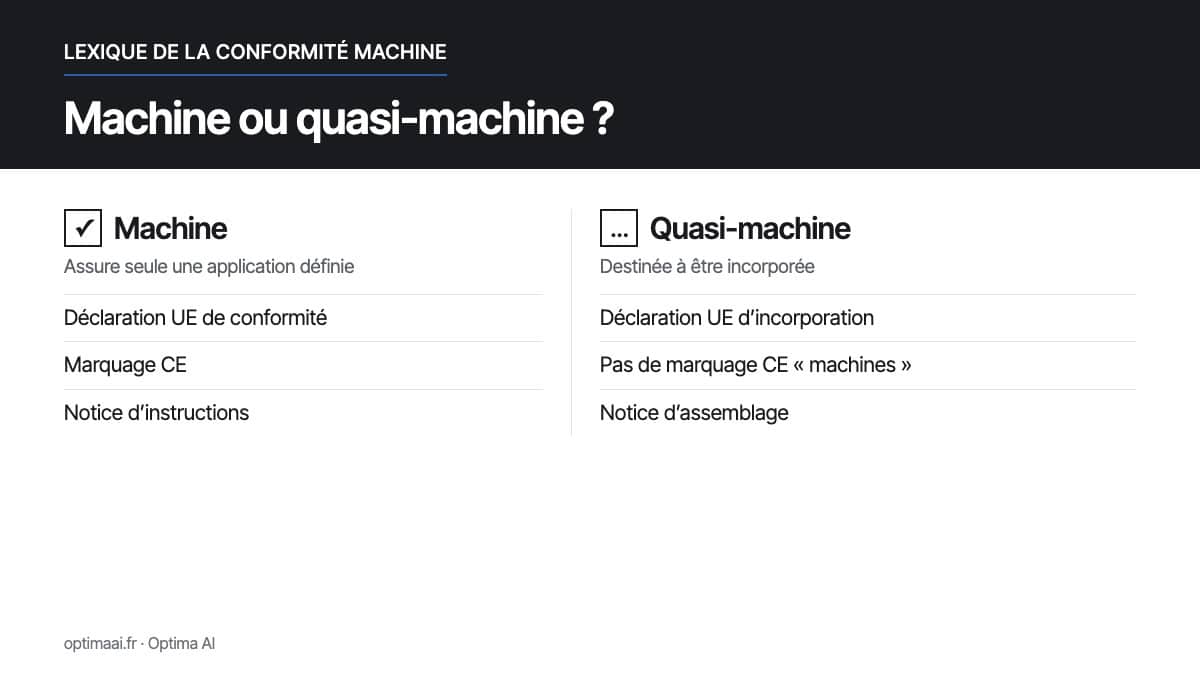
A quasi-machine is an assembly that does not yet constitute a machine, because it cannot by itself ensure a defined application, and that is intended solely to be incorporated or assembled into a machine, other quasi-machines, or equipment to form a machine. This is the definition of Article 3, point 10, of Regulation (EU) 2023/1230 on machinery, which applies from January 20, 2027. Under the machinery regulation, a quasi-machine does not receive an EU declaration of conformity: it is accompanied by an EU declaration of incorporation and an assembly instruction.
In short
- A quasi-machine does not work alone for a defined application: it waits to be integrated.
- Its manufacturer draws up a technical documentation, an EU declaration of incorporation and an assembly manual (Article 11 of Regulation 2023/1230).
- It does not bear the CE marking under the Machinery Regulation, which reserves it for machinery and related products (Article 24).
- It must not be put into service until the final machine has been declared compliant with the machinery regulations.
What the text says
Regulation (EU) 2023/1230 defines a quasi-machine as «a set that does not yet constitute a machine, as it cannot by itself ensure a defined application, and which is intended solely to be incorporated or assembled with a machine or other quasi-machines or equipment in order to constitute a machine» (Article 3, point 10).
Directive 2006/42/EC, which applies until January 19, 2027, gave a close definition of it, with an example: «A training system is a quasi-machine.» This example is no longer included in the definition of the regulation.
The quasi-machines are only made available on the market if they meet the essential health and safety requirements «relevant» to Annex III, that is to say those that can be met before incorporation (Article 8; Annex III, point 1.1.1).
What this changes for the manufacturer and the integrator
For the manufacturer of the quasi-machine
Article 11 of the regulation requires it to:
- comply with the relevant essential requirements and carry out a risk assessment according to the same principles as for a machine (Annex III, General principles, point 5);
- establish the technical documentation of Annex IV, Part B;
- draw up the EU incorporation declaration, in accordance with the model in Annex V, Part B: it specifies which essential requirements are applied and fulfilled (Article 22 and Annex V, Part B, point 5);
- provide an assembly instruction (Annex XI), which describes the conditions to be met for the quasi-machine to be properly incorporated without compromising health and safety;
- Keep the technical documentation and the declaration available to the authorities for at least ten years.
For the integrator
Whoever incorporates the quasi-machine into a machine, then places that machine on the market or puts it into service for their own use, is the manufacturer (Article 3, point 18). He relies on the declaration of incorporation and the assembly manual, addresses the essential requirements that the manufacturer of the quasi-machine did not cover, conducts the risk assessment of the whole, implements the applicable conformity assessment procedure (Article 25), and then draws up the EU declaration of conformity and places the CE marking on the final machine. The declaration of incorporation also includes the indication that the quasi-machine «is not put into service until the final machine in which it is to be incorporated has been declared compliant with this Regulation» (Annex V, Part B, point 8).
An example
An industrial robotic arm is delivered without a gripper, without a protection cell and without an application program. By itself, it performs no defined task: it is a quasi-machine. Its manufacturer provides a declaration of incorporation and an assembly manual. The integrator who installs it in a palletizing cell, with gripper, protectors and controls, designs a machine: it is he who performs the complete risk assessment, the EU declaration of conformity and the CE marking.
Common mistakes
- Delivering a quasi-machine without assembly instructions, Or with a simple user manual: the integrator does not have what he needs to incorporate it safely.
- Confusing the incorporation declaration with the compliance declaration. The first one accompanies a quasi-machine; the second, a complete machine.
- Apply an CE marking for «machines» on a quasi-machine. It can be based on other European texts that require it; its declaration of incorporation then specifies this.
- To think that the integrator has nothing to do with it because each element has its own statement: the whole must be evaluated as a machine.
Semi-machine or machine: how to tell the difference?
A question often suffices: once assembled, can the whole system perform the application for which it is designed? If so, it is a machine, even if it lacks only the connecting elements with the site of use or connection to energy and motion sources, or the downloading of its application software (Article 3, point 1, b and f). If not, and if it is intended solely to be incorporated, it is a quasi-machine. A set of machines or quasi-machines controlled in a coordinated manner for the same result forms, for its part, a machine (Article 3, point 1, d).
Related terms: machine, declaration of incorporation, assembly instructions, complete machine, essential health and safety requirements, CE marking.
Frequently asked questions
Does a quasi-machine bear the CE marking?
Not under the Machinery Directive: Article 24 concerns machines and related products. Almost all machines are accompanied by an EU declaration of incorporation. If they fall under another European text that requires a declaration of conformity, their declaration of incorporation specifies this. The steps involved in CE marking, and the case of the quasi-machine, are detailed in our article. CE marking of a machine.
What documents accompany a quasi-machine?
The EU incorporation declaration (Annex V, Part B), or the internet address or code that allows access to it, and the assembly instructions (Annex XI). The manufacturer also keeps a technical documentation (Annex IV, Part B) for at least ten years.
Is a training system a quasi-machine?
Directive 2006/42/EC explicitly stated this (article 2, point g). Regulation 2023/1230 does not include this example: the definition of article 3, point 10, must be applied to the product concerned. Electric motors, insofar as they fall under Directive 2014/35/EU or Directive 2014/53/EU, are excluded from the machinery regulation (article 2, paragraph 2, point p, vi).
Who is responsible for the security of the final machine?
The person who incorporates the quasi-machine and places the final machine on the market, or puts it into service for their own use: they is the manufacturer (Article 3, point 18). They implements the applicable conformity assessment procedure (Article 25), establishes the EU declaration of conformity and places the CE marking.
Sources
- Regulation (EU) 2023/1230 on machinery, consolidated text of 27 July 2026 Article 2 (paragraph 2, point p), Article 3 (points 1, 10 and 18), Articles 8, 11, 22, 24 and 25, Annex III, Annex IV Part B, Annex V Part B, Annex XI (EUR-Lex)
- Directive 2006/42/CE on machinery, Article 2, point g, and Article 13 (EUR-Lex)
Updated definition as of October 30, 2026. It does not replace the reading of the official text. Find our articles on the documentation machine and our webinar Machine Regulations 2023/1230: What changes on January 20, 2027.
By Philippe, regulatory expert at Optima AI. As a manufacturer or integrator, are you preparing the documentation for your machines? Optima Compliance, Our machine compliance offering helps you draft, control and keep these documents up to date based on yours.
 French
 English