
By Philippe, regulatory expert at Optima AI · Updated on November 3, 2026
The risk analysis of a machine, which the EN ISO 12100 standard addresses under the title «risk assessment and risk reduction», is the process by which the manufacturer sets the limits of his machine, identifies its hazards, estimates and assesses each risk, and then reduces it in an imposed order: design first, protections afterwards, information last. It is mandatory before any placing on the market or putting into service, today under Directive 2006/42/EC, and from January 20, 2027 under Regulation (EU) 2023/1230. Here is the six-step method, an example with commentary and the errors that make it useless.
In short
- Regulation (EU) 2023/1230 requires the manufacturer to ensure that a risk assessment is carried out (Annex III, General principles, point 1). The EN ISO 12100:2010 standard describes how to carry it out.
- The method follows five time limits set by the regulation: machine limits, hazards, estimation, evaluation, and reduction. A sixth step, documentation, keeps a record of it.
- Risk reduction follows a mandatory order: eliminate the danger through design, then protect, then inform about residual risks.
- The manufacturer’s risk analysis is not the employer’s only risk assessment document: these are two separate obligations that complement each other.
What is the risk analysis of a machine?
It is the study, carried out during design, of everything that can injure a person around a machine, and of the measures that eliminate or reduce these risks. Three expressions recur, which do not quite cover the same thing:
- « risk assessment » The text of Regulation (EU) 2023/1230 and Directive 2006/42/EC;
- «assessment of risk» The word of the standard EN ISO 12100:2010, Machine safety — General design principles — Risk assessment and risk reduction ;
- « risk analysis » The words of the design offices and workshops apply to the entire process; in the standard, the ’risk analysis« only covers the beginning (limits, dangers, estimation).
The regulation defines the two basic concepts. One danger is «a potential source of injury or harm to health». A risk is the «combination of the probability and the severity of a lesion or health impairment that may occur in a hazardous situation» (Annex III, Part A). A rotating knife is a danger; the operator who disengages the machine without stopping is exposed to a risk.
Who should perform the risk analysis of a machine?
The manufacturer, This is the person who manufactures the machine, or designs or manufactures it, and markets it under their own name or brand; it also includes the industrialist who builds a machine and puts it into service for their own use (Article 3, point 18). The regulation extends this to three situations that are often forgotten:
- the manufacturer of a quasi-machine, an ensemble that cannot function alone and that is intended to be incorporated into a machine: the same principles apply to its risk assessment (Annex III, General principles, point 5);
- the integrator of a set of machines The assessment includes «the risks resulting from interactions between machines» ordered in a coordinated manner (Annex III, General Principles, point 1);
- the one who brings about a substantial change to a machine, including the operator who transforms it in his factory: he is considered «a manufacturer for the purposes of this regulation» and assumes the obligations for that machine (article 18). Only the non-professional user who modifies his machine for his own use is exempt from these obligations.
The manufacturer can entrust the work to a design office or a consultant. He remains responsible for it: it is he who signs the declaration of conformity.
And the employer who uses the machine?
It has its own obligation, provided for by the Labour Code: to assess the risks to the health and safety of workers, «including in the choice […] of work equipment» (article L4121-3), and to document these findings in the single document for the assessment of occupational risks, the DUERP (article R4121-1).
| Manufacturer's risk analysis | Employer’s risk assessment | |
|---|---|---|
| Text | Regulation (EU) 2023/1230, Annex III (Directive 2006/42/EC, Annex I, until 19 January 2027) | Labour Code, Articles L4121-3 and R4121-1 |
| What she watches | The machine, throughout its entire life, for all its predictable users | The real position, in the workshop, with its employees |
| When | During design, before being put on the market | Before commissioning, and then at each changeover |
| Where it leads | Technical documentation, instruction manual | DUERP, instructions, safety sheet at the station |
The two complement each other: the residual risks that the manufacturer indicates in its instructions are a starting point for the employer, who adds to them what the manufacturer could not know (the location, organization, and people).
The ISO 12100 method, step by step
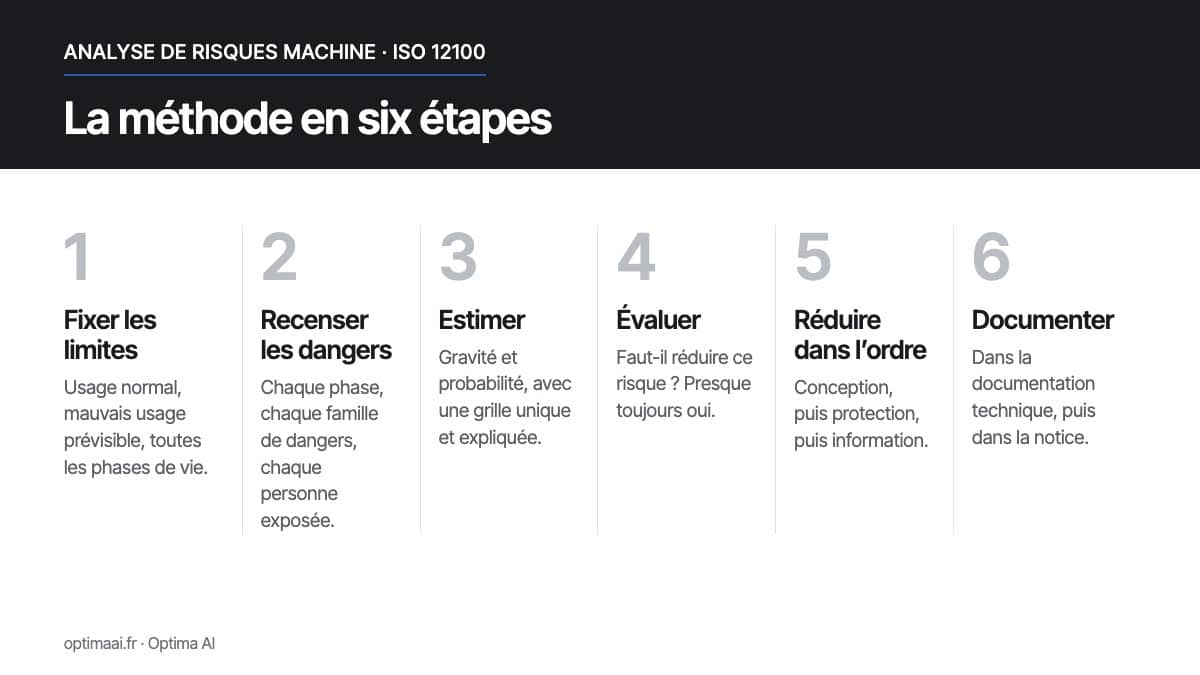
The regulation sets out the five-step procedure, in its general principles (Annex III, point 1, a to e). The EN ISO 12100 standard details it. It is iterative Every additional protective measure is itself verified, as it can create a new danger.
1. Fix the machine's limits
The manufacturer «determines the limits of the machine […], including its normal use and any reasonably foreseeable misuse». Specifically, it is written:
- what the machine does, with what products, at what speed;
- who approaches it: operator, regulator, maintenance agent, cleaning agent, passer-by;
- all phases of its life: transport, assembly, adjustment, production, cleaning, breakdown repair, maintenance, dismantling, disposal (Annex III, point 1.1.2, a);
- the foreseeable misuse: the machine being switched on, the protective cover removed «just for a setting», the wrong material loaded.
2. Identify the dangers and dangerous situations
We examine every phase of life for every possible danger: mechanical (crushing, shearing, cutting, traction, entanglement, shock), electrical, thermal, noise, vibrations, radiation, materials and substances, ergonomics, slipping and falling, and those related to the machine’s environment. For each danger, we note: dangerous situation : who is exposed, for what task, and what can trigger the accident.
3. Estimate each risk
The manufacturer «assesses the risks, taking into account the severity of a possible injury or health impairment and their probability». No text imposes a quantified threshold. Most design offices use a severity scale (from minor injury to death) and a probability scale, which takes into account the frequency of exposure and the possibility of avoiding the accident. What matters: the same threshold for the entire analysis, explained in the document.
4. Evaluate: is it necessary to reduce this risk?
The assessment compares the estimated risk with the objective of the regulation, to decide whether a reduction is necessary. No quantified threshold is set: the risk must be reduced until the essential health and safety requirements of Annex III are met, which are mandatory. When the state of the technology does not allow them to be achieved, the machine is, «as far as possible,» designed and built «to strive towards these objectives» (general principles, point 3). If the reduction is not sufficient, we return to step 5, and then we evaluate again.
5. Reduce the risk, in the order imposed
The regulation imposes three levels, «in the order indicated» (Annex III, point 1.1.2, b):
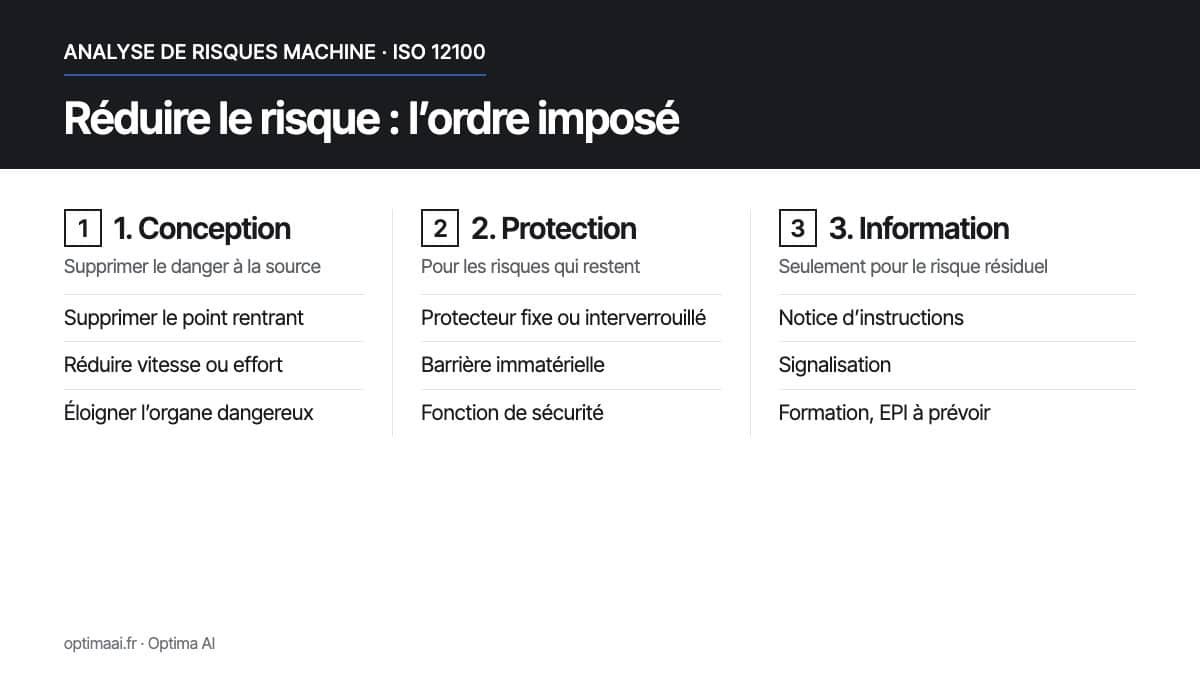
- Eliminating the danger or minimizing the risk through design Eliminate the risk factor, reduce speed or effort, or move away from dangerous organs. This is called intrinsic prevention.
- Protecting against the remaining risks Fixed or mobile protective devices with interlock mechanism, non-material barriers, bilateral controls, and safety functions of the control system.
- Inform about residual risks : instructions for use, signage, necessary training, individual protective equipment to be provided.
Going directly to level 3 by writing «do not put your hand» in the instruction manual when a protector was possible is a common deviation, and the imposed order prohibits it.
6. Documenting
The technical documentation contains «the documentation on the risk assessment, describing the procedure followed», together with a list of the essential requirements that apply, the description of the protective measures and, where applicable, the residual risks (Annex IV, Part A, point b). The residual risks then appear in the instructions for use: our article Machine instruction sheet: what it should contain Show me where to place them.
Example of machine risk analysis: a belt conveyor
Here is a fictional excerpt for a motorized belt conveyor that feeds a packaging station. It shows the shape of an analysis line, not a complete analysis: a true analysis counts tens of lines. Gravity (G) from 1 (minor injury) to 4 (irreversible or fatal injury); probability (P) from 1 (unlikely) to 4 (common). This grid is an example to adapt.
| Phase | Danger and dangerous situation | G × P before | Measurement (level) | G × P after | Residual risk, and where it is reported |
|---|---|---|---|---|---|
| Troubleshooting | Hand training at the return point between the band and the return drum, removing a stuck card while the machine is running (predictable misuse). | 4 × 3 | Fixed protector covering the drum, removable only with a tool (2) | 4 × 1 | Low, related to the disassembly of the protector: reserved for maintenance, after consignment (notice, chapter maintenance) |
| Cleaning | Training while cleaning the band, if the conveyor restarts | 4 × 2 | Lockable circuit-breaker; consignment procedure (2, then 3) | 4 × 1 | Mandatory pre-cleaning deposit (notice and pictogram) |
| Production | Package falls off conveyor at operator’s feet | 2 × 3 | End-of-run stopper and reduced transfer height (1) | 2 × 1 | Recommended safety shoes (notice) |
| Maintenance | Cut by changing the band, sharp edges of the chassis | 2 × 2 | Curved and chamfered edges (1) | 1 × 2 | Gloves recommended during the band change (notice) |
| Assembly | Conveyor shift during installation | 3 × 2 | Ground anchors, indicated center of gravity (1 and then 3) | 3 × 1 | Fixation to the ground before commissioning (notice, chapter installation) |
Three things to remember from this example. Each line names an task, Not just a danger. Each measure indicates its level (1, 2 or 3), which shows that the imposed order has been respected. And each residual risk is said to be where It is noted that this is what links the risk analysis to the notice.
What tools are available for risk analysis?
- The analysis table, As above: one line for each dangerous situation. This is the most common form, on a spreadsheet or in a software program.
- Preliminary risk analysis (APR) : a first pass, early in the project, to identify major hazards before the design is finalized.
- AMDEC (analysis of the modes of failure, their effects and their criticality): useful for organ or control failures, as a complement.
- The standards of detail The ISO/TR 14121-2 technical report provides practical guidelines and examples of methods; EN ISO 13849-1 deals with the parts of the control systems related to safety, when a safety function reduces a risk.
A tool does not replace knowledge of the machine. The best analysis is carried out by a small team: the designer, someone who has done maintenance, and an operator of a comparable machine.
Errors that make a risk analysis useless
- Don't just look at the production. Serious accidents often occur during cleaning, adjustment or repairs.
- Forgetting the foreseeable misuse. The regulations require it; that is often where the real accident occurs.
- Replacing protection with a warning. Information comes last, when design and protection are not enough.
- Analyzing it afterwards, The machine was built to fill out the paperwork. It is meant to guide the design process, not justify it.
- Not updating it when the machine changes. A substantial modification makes the author a manufacturer (article 18).
- Do not postpone the residual risks in the instructions. An analysis without follow-up in the instructions does not protect anyone.
And after the risk analysis: the notice, without starting from scratch
A well-prepared risk analysis is the raw material for the instructions for use: the residual risks, the instructions, and the personal protective equipment are discussed one by one. Optima Compliance, Our machine compliance offering starts with your own documents. Optima Doc Creation, in its pilot version, with support, drafts a first draft of the notice, in 14 structured sections according to EN ISO 20607, based on your functional analysis and risk analysis; you read, correct, and validate it. Optima Machine Risk It concerns risk assessment, with EN ISO 12100 as the framework; it is under development, with no announced date.
The tool prepares. Your expert revises, corrects, and validates: no analysis is delegated entirely, and the declaration of conformity remains under your signature.
Frequently asked questions
Who should perform the risk analysis of a machine?
The manufacturer, before placing the product on the market. This also applies to the manufacturer of a quasi-machine, the integrator of a set of machines for risk related to interactions, and to any person who makes a substantial modification to a machine (Article 18 of Regulation 2023/1230). He may entrust the work to an engineering office, but remains responsible for it.
Is the ISO 12100 standard mandatory?
No, a standard remains voluntary. What is mandatory is the risk assessment itself (Annex III to Regulation 2023/1230). A machine that complies with harmonized standards whose references are published in the Official Journal of the European Union is presumed to comply with the requirements it covers (Article 20). EN ISO 12100 is the reference standard for carrying out the risk assessment.
What is the difference between machine risk analysis and DUERP?
The risk analysis is carried out by the manufacturer, on the machine, before it is placed on the market. The DUERP is kept by the employer, on the actual positions of his company (articles L4121-3 and R4121-1 of the Labor Code). The employer relies on the manufacturer’s instructions, but cannot be content with them alone.
Should the risk analysis be repeated after a modification of the machine?
Yes, at least in the modified part. If the modification is substantial in the sense of the regulation, that is to say not planned or planned by the manufacturer, and that creates a new danger or increases the existing risk to the point of requiring either protective guards or protective devices whose implementation requires modifying the existing safety control system, or additional protective measures for stability or mechanical resistance (Article 3, point 16), the author becomes the manufacturer and takes over the entire process for the concerned machine.
Is there an official machine risk analysis model in PDF format?
No. Neither the regulation nor the standard impose a model. The table in the example above summarizes the useful columns: phase, danger and situation, pre-estimation, measurement and its level, post-estimation, residual risk and where it is reported. The ISO/TR 14121-2 technical report provides examples of methods.
Sources
- Regulation (EU) 2023/1230 on machinery, consolidated text of 27 July 2026 Article 3, Article 18, Article 20, Annex III (Part A and General Principles), Annex IV (EUR-Lex)
- Directive 2006/42/CE on machinery, Annex I, General principles (EUR-Lex)
- Labour Code: L4121-3, R4121-1 (Digital Labour Code)
- EN ISO 12100:2010, Machine safety — General design principles — Risk assessment and risk reduction (title only; text paid for)
- ISO/TR 14121-2, Machine safety — Risk assessment — Part 2: Practical guidelines and examples of methods (title only)
 French
 English