
By Mathieu Domon, President of Optima AI · Updated November 4, 2026
There is no one best AI for a company, but an AI tailored to each task. Using ChatGPT in business is suitable for writing, reformulating, or summarizing non-confidential texts; the professional offering of an assistant or AI integrated into your software is suitable as soon as your data are involved, provided that the contract states what the provider does with it; a tool or business agent is suitable when a specific task occurs frequently and involves your own documents. Here are the four tool families, the five questions that allow you to choose, and what the texts say about them.
In short
- Four families: the general public assistant, the professional offering of an assistant, AI integrated into the software you already use, and the tool or agent designed for a specific profession.
- The choice depends on the task and the data, not the most well-known tool.
- No text prohibits the use of ChatGPT at work. However, if personal data is processed there, the General Data Protection Regulation applies, and the company can regulate the use through a charter.
- A personal account, even if paid for, does not bind the company to the provider: as soon as internal documents or personal data are involved, it is the contract for the offer subscribed by the company that must be read.
The four families of AI tools in the enterprise
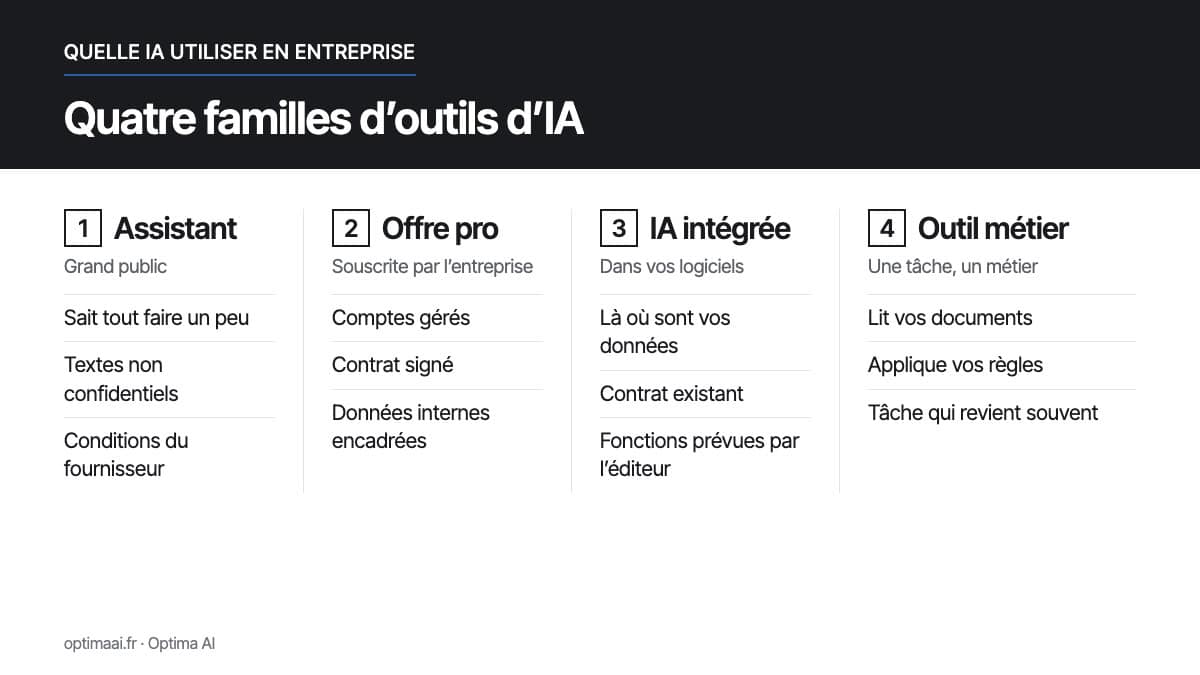
1. The general public conversational assistant
ChatGPT, Copilot, and their equivalents, used with a personal account, free or paid. You ask a question, you paste some text, the tool answers. This is the gateway for most employees. Its strength: it can do almost everything. Its weakness: it only knows what you give it, and what you enter there depends on the provider’s conditions, not yours.
2. The professional offer of an assistant
The same type of tool, subscribed by the company: company-managed accounts, centralized administration, contract signed with the provider. The difference lies not in the answers but in the framework: who accesses what, what the provider does with the data entered, where it is processed. These points are outlined in the contract, offer by offer.
3. AI integrated into the software you already use
Messaging, word processing, management software, accounting or customer relationship management: many publishers are adding AI functions to their tools. The advantage: the AI works where your data already resides. But the AI function can be subject to separate conditions, or involve a third-party provider other than the publisher: check this before passing on personal data. The limit: it does what the publisher has planned for all its customers.
4. The tool or agent designed for a particular profession
Software that performs a specific task in a particular profession, with the rules of that profession: analyzing a tender file, writing a machine instruction sheet, sorting through requests. When it links several steps in your documents to achieve a result, we’re talking about an AI agent; our article Agent IA in the workplace: what it is, what it does details the difference with an assistant.
How to choose: five questions to ask yourself
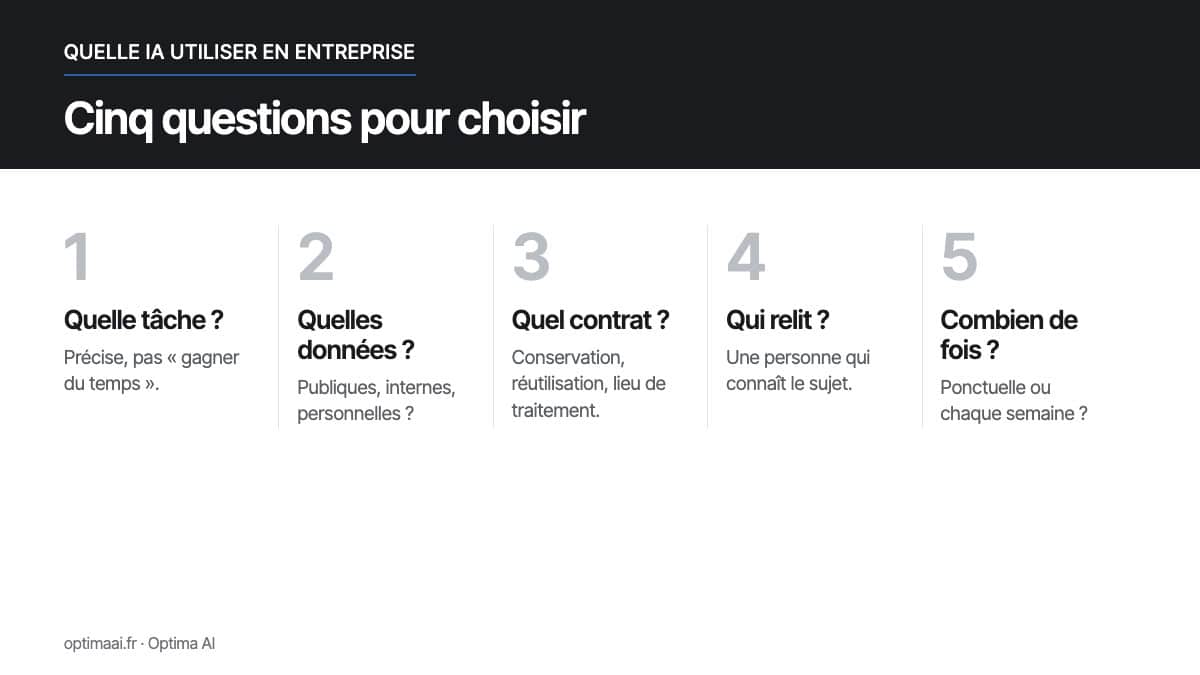
- What task exactly? «Saving time» is not a task. «Responding to requests for quotes received by email» is. The more specific the task is, the simpler the choice becomes.
- What data passes through the tool? A public text, an internal document, customer information, personal data? This is the question that eliminates the mass-market tool the fastest.
- What contract? Are the entered data stored, reused to train a model, or processed outside the European Union? Does the provider sign a subcontracting contract if personal data is involved?
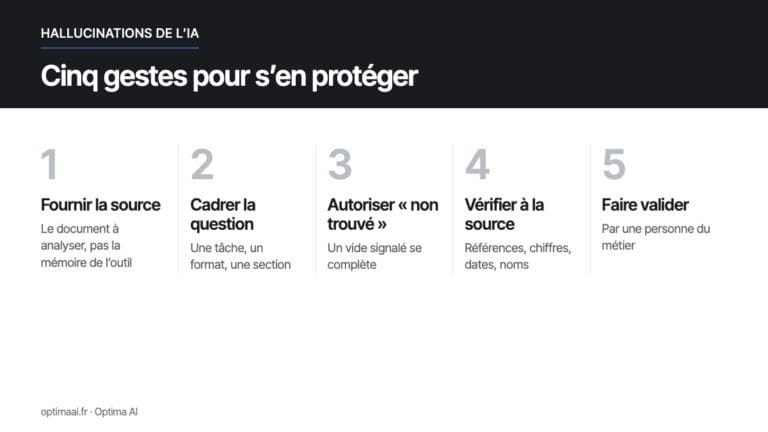
- Who reads it? Une IA générative peut produire un résultat faux mais plausible. Si le résultat part chez un client, une personne qui connaît le sujet le vérifie. Pourquoi l’IA se trompe, et comment s’en protéger : AI hallucinations.
- How many times does the task recur? A one-off task is very well done with an assistant. A task that comes back every week, always on the same type of document, justifies a tool that handles it from start to finish.
What AI for what use?
| Usage | Adapted family | Why |
|---|---|---|
| Find title ideas for an article or presentation | General public assistant | Nothing confidential, and the person who publishes it reads it again |
| Translate a product fiche already published on your site | Assisted, with a person who reads the language as a reviewer | The text is public; an error, however, would be noticed by the client. |
| Summarizing an internal meeting report | Professional offer or integrated AI | Internal information: the contract must regulate it |
| Prepare a refresh based on the customer file | AI integrated into the customer relationship software | Personal data: the tool that already contains them, if its contract also covers the AI function |
| Analyzing each tender file received | A professional tool | Common task, long documents, rules specific to public procurement |
| Managing a task specific to your company that comes up every day | Agent designed for this process | No market tool applies your rules without you giving it back to it every time. |
Can ChatGPT be used in business?
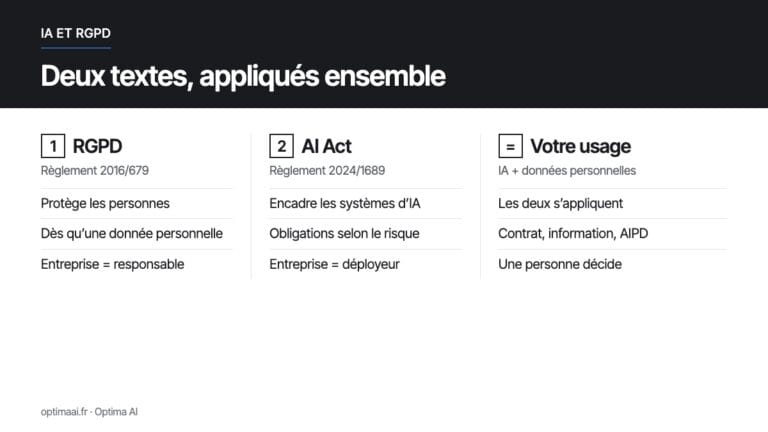
Yes. No text itself prohibits the use of ChatGPT at work, but the employer can regulate or restrict it, for example in a charter. Two regulations and the recommendations of the CNIL regulate this use.
Personal data
If an employee enters personal data (clients, candidates, colleagues), the General Data Protection Regulation applies. When a provider processes this data on behalf of the company, Article 28 requires that only subcontractors with «sufficient guarantees» be used and that a contract be signed that governs the processing. With a personal account, whether free or paid, this contract does not exist between the company and the provider. What the GDPR requires when AI touches personal data: AI and GDPR.
The recommendations of the CNIL
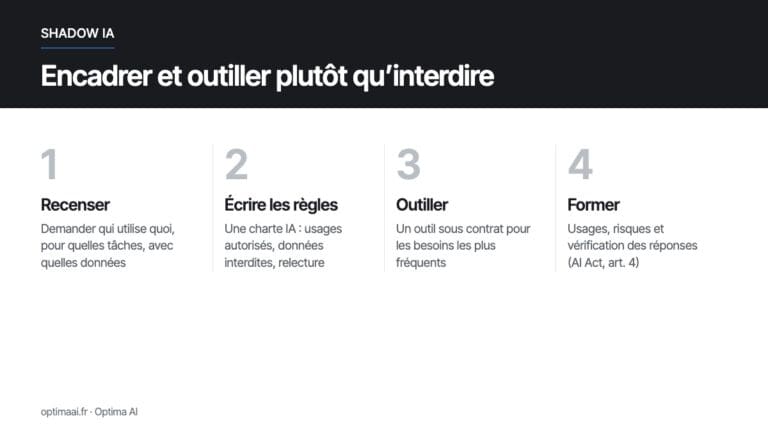
For any organization deploying generative AI, the CNIL recommends, in particular, starting with a concrete need, defining a list of permitted and prohibited uses, determining whether the provider is likely to reuse the provided data, and adapting the use accordingly, and training users.
The European regulation on AI
Since July 27, 2026, Article 4 of Regulation (EU) 2024/1689, replaced by Regulation (EU) 2026/1744, requires companies that use AI systems to «take measures to promote the development of AI mastery» by their staff. The text does not specify which ones. A code of conduct and a short training course are part of this: see our articles IA Charter in the workplace and Mandatory AI training in the workplace?
Common mistakes when choosing an AI
- Choose the tool before the task. A subscription for everyone, without specific usage, often ends up unused.
- Buying licenses without reading the contract. A professional offer only protects what is stipulated in its contract: data retention, reuse, and the place of processing.
- Compare the tools during demonstrations rather than on a real task, with your own documents.
- Forget about reviewing. The time saved disappears if a mistake is made by a customer.
- Looking for a custom-made tool when a software package from the market is sufficient, or the opposite: forcing a general tool on a very specific task.
And what if no market tool fits your task?
For a widespread task, there is often a business software: Optima Proposal Manager, For example, our software is used to respond to tenders, both public and private. For a task specific to your company, Optima Studio concepte an AI agent, or a simple software program when a rule is enough: an agent, a process.
Three signs show that a task is suitable for it: nothing matches on the market, it is not written anywhere, and it often comes up again. If a software on the market already does the job, or if no tool would change anything about it, we tell you about it right from the start. The method for identifying this first task is in our article. Integrating AI in SMEs: where to start?
Frequently asked questions
Which AI should be used in a company?
The one that corresponds to the task and the data involved. A general-purpose assistant is sufficient for non-confidential texts; the professional offering of an assistant or AI integrated into your software is suitable as soon as internal or personal information passes into the tool, provided the contract frames what the provider does with it; a tool or a business agent is suitable for a specific task that often occurs.
What is the best AI for a small business?
There isn’t one. A small business benefits from one or two specific tasks: testing a tool on its own documents, and writing some usage rules before expanding. The right tool is the one that the teams actually use, with data they are allowed to put there.
Is it legal to use ChatGPT at work?
Yes, no text prohibits it. However, the employer can regulate or restrict this use, for example in a charter. And if personal data is entered there, the General Data Protection Regulation applies, including Article 28 on subcontractors.
What is the difference between ChatGPT and a business AI agent?
ChatGPT responds to a request based on what you give it. A business agent is designed for a specific task: it reads your documents, applies the rules of your field, and follows the steps until the result is achieved, which is then reviewed and validated by a person.
Do I need a professional account to use ChatGPT in a business?
Not to reformulate a text without sensitive information. As soon as internal documents or personal data are involved, there must be at least an offer signed by the company, whose contract frames these data: with a personal account, free or paid, there is no contract between the company and the provider, and Article 28 of the General Data Protection Regulation requires one to be signed as soon as a provider processes personal data on behalf of the company. For team training, see our article Mandatory AI training in the workplace?
 French
 English