

By Mathieu Domon, President of Optima AI · Updated October 27, 2026
An AI agent is software that receives a goal, reads the information it needs (documents, emails, data), and alone carries out the steps to produce a result, within predefined limits. In business, it is used to take over a task that often involves reading, sorting, comparing, or writing; the person who performed that task reads and validates the results. Here's how to recognize an AI agent, concrete examples by industry, and a simple test to determine whether a task in your company deserves one.
In short
- An AI agent does not simply respond: it pursues an objective, follows several steps, and produces a result, with a degree of autonomy determined in advance.
- It differs from a conversational assistant, where you lead the conversation question by question, and from a classic automation, which applies a written rule in advance.
- It is useful when the task often involves reading, sorting, or writing. When the calculation is known in advance, a simple program is sufficient.
- For the European regulation on AI, an AI agent is a «system of AI»; the company that uses it must «take measures to promote the development of AI mastery» by its staff (article 4, in its wording in force since July 27, 2026).
- A good agent does one thing: work on the documents that the task already uses, report what they don’t find, and leave the validation to someone with the necessary expertise.
What is an AI agent?
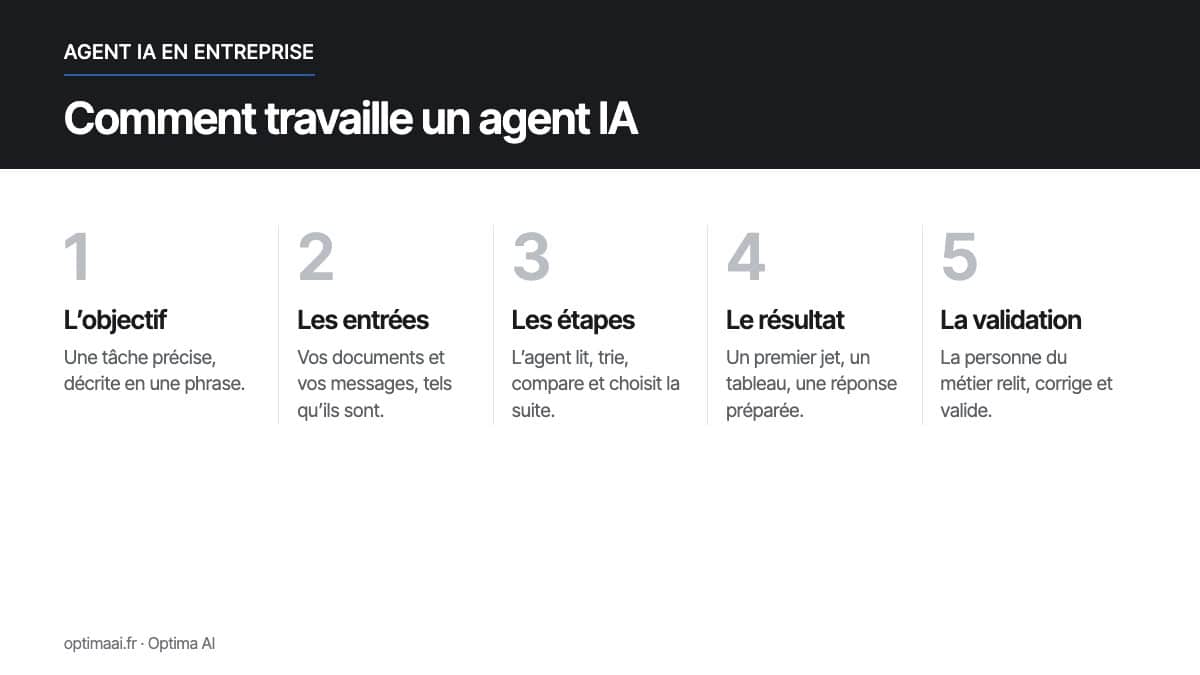
An AI agent is a program that uses an artificial intelligence model to achieve a goal, rather than to answer a single question. It is tasked with a task («prepare the answer to this questionnaire based on our documents»); it decides the steps itself: searching for the right files, extracting the information, comparing them, writing the answer, and then delivering the result.
The Council on Artificial Intelligence and Digitalization (CIANum), cited by the CNIL innovation laboratory in September 2026, gives this definition: «An AI agent is a computer program capable of taking decisions or performing actions, including coordinating them among themselves, based on artificial intelligence models.» The same text cites Inria to designate what makes the difference: «It is this notion of autonomy in action (and not just access to information) that characterizes the agentic AI.».
In practice, an enterprise AI agent gathers a specific objective, inputs (the documents the task already uses), tools it is authorized to use, and limits: what it never does alone, and the person who validates its work.
What is the difference between an AI agent, a conversational assistant, and automation?
The three often use the same bricks, but not in the same way. The useful question is: who is doing the work, and what is it about?
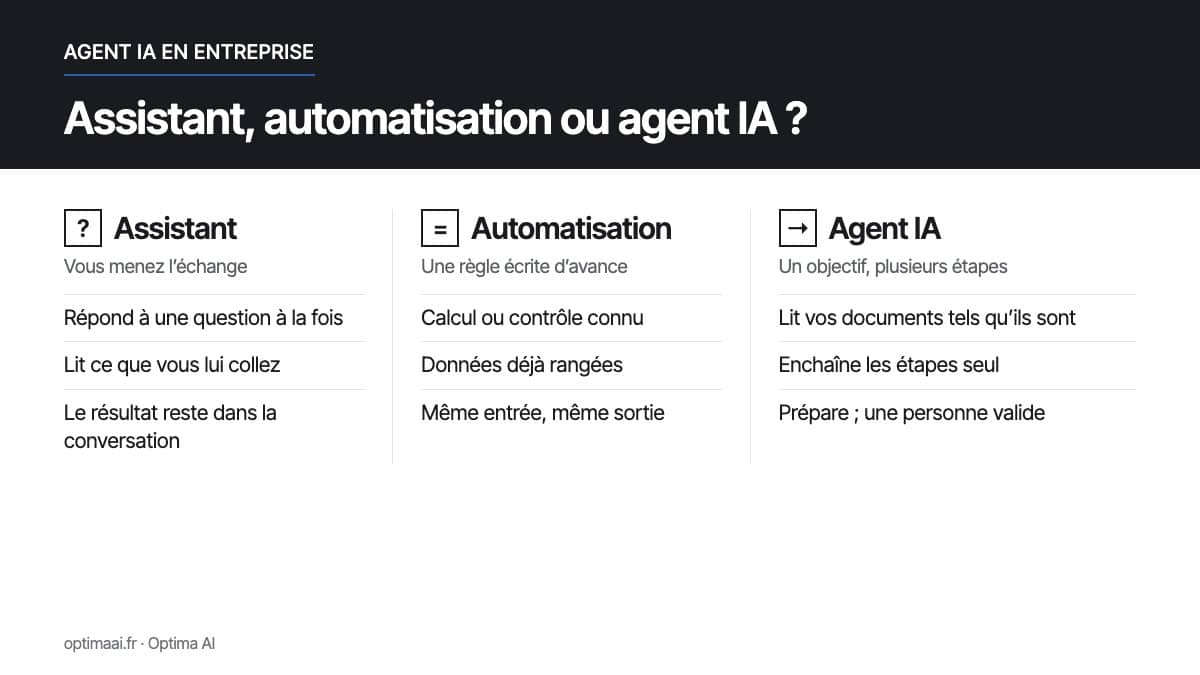
| Conversational assistant | Classical automation | Agent IA | |
|---|---|---|---|
| Who leads | You, question after question | A written rule in advance | The agent, towards a fixed goal |
| What he reads | What you put on him | Data already sorted | Free-text documents: PDFs, emails, Word files |
| What he produces | An answer in the conversation | Always the same exit for the same entrance | A deliverable: a first draft, a painting, a prepared response |
| When to choose it | A specific question | A calculated or known control in advance | A repetitive task that requires reading, sorting, or writing |
A classic automation is reliable when the rule is known (checking that a field is filled in, passing data from one software to another), but it crashes as soon as the information arrives in free text, scanned PDF, or via email. That’s where an AI agent takes over.
What is the purpose of an AI agent in a company?
An AI agent is used to take over tasks that come back without anyone having chosen them, and which mainly consist of reading, sorting, comparing, finding, or writing. Often, no one has ever written them: they are in the minds of a few people.
What he doesn’t count on as much is:
- Decide in your place. Determining whether a quote is valid or whether a risk is acceptable remains a matter of experience.
- Replacing a known calculation. If the rule can be written down, a simple program will do the same job, always in the same way.
- Resolve an organizational problem. If the information is scattered because no one knows who is doing what, a tool will not solve the problem.
Value does not come from the tool, but from the way it is used. A well-designed AI agent takes over the task, not the job: the person who used to do it becomes the one who validates it.
What concrete examples of AI agents, by profession?
Here are tasks that lend themselves to an AI agent in SMEs and large enterprises. These are typical examples, not real projects: for each one, what the agent prepares and what the person keeps.
| Profession | The task that falls to us | What the agent is preparing | What the person keeps |
|---|---|---|---|
| Workshop, production | Re-reading a client’s specifications sheet | The list of what concerns the workshop: materials, tolerances, and the controls requested | Saying whether the workshop knows how to do it |
| Maintenance, technical service | Checking an intervention report | The discrepancies between the report and the home procedure | Deciding whether the report goes to the client |
| Commercial, quality | Fill out the referral marketing questionnaire from an order processor | The answers, drawn from your internal documents, and the list of what they do not say | Complete, correct, sign |
| Purchases | Compare technical sheets from suppliers | A table showing the differences with your own requirements | Choosing the provider |
| Quality, safety | Reinstating an internal rule when a standard changes | The affected passages and a proposal for a rewrite | Validate the new instruction |
| Federation, network, support | Answering the same technical question posed by another member | A prepared response, with the passages from the documents that support it | Read and send again |
An example we know from the inside: machine documentation. Optima Doc Creation, one of the agents of Optima Compliance (our offering for machine compliance), writes the first draft of the instruction manual, in 14 structured sections according to EN ISO 20607, based on the functional analysis and risk analysis of the machine, which must already be formalized. What the documents do not say is reported as «Not found» rather than invented, and the team that fully knows and validates the machine. This agent is currently in pilot version, with support. This is not an Optima Studio project, but one of our software, designed by the same team.
One task is intentionally missing from this tableau: recalculating the price of an off-catalog product. When the calculation rules are known, even if everyone applies them in their own way, the real work is writing them down and then programming them. This is not the work of an AI agent.
How do we know if a task justifies an AI agent?
Before talking about a tool, ask four questions about the task:
- Does she ask you to read, sort, or write? If it’s a calculated or pre-known control, a program is enough.
- Does she come back often? An agent justifies himself when the volume is real, not for a task twice a year.
- Is there already a software on the market that does this? If so, it is often the best choice.
- Does anyone know how to do this and judge the result? Even though the method is not written anywhere, there must be someone who can tell whether the agent’s work is correct.
If the difficulty lies in the organization rather than the task, the first step is a review of the current situation. For the agricultural cooperative ValFrance, our mission was to diagnose its information system, without AI, and to conclude with a roadmap for its reorganization.
In practice: the profile of an AI agent, to be filled out before building it
- Objective The task, in a nutshell («prepare the answers to the referencing questionnaire for a new client»).
- Entrées : the documents that the task really uses, as they are.
- Available for delivery What the agent renders, in what format (Word file, spreadsheet, prepared email).
- What he is entitled to do, And what he never does alone: send, sign, decide.
- What he reports instead of inventing : any information absent from the documents.
- Who validates : the name and the function of the person who reads the text aloud.
- The point of comparison : how many times the task comes back and the time it takes today, noted before starting.
How to create an AI agent for your company?
There are three paths, depending on the task:
- Do it yourself with the functions of creating conversational assistant agents from the market, such as ChatGPT or Copilot: adapted to a personal task, on less sensitive documents.
- Using software from the market which already employs agents for your profession, when the task is the same from one company to another.
- Have a custom-made agent designed when nothing matches on the market, the task follows rules specific to your company and it often repeats itself.
In all three cases, the method is the same: one task at a time, real projects to try it out, and the person who was doing the task next to them. The way to choose this first task is detailed in our article Integrating AI in SMEs: where to start?
What does the European regulation on AI say about an AI agent?
Regulation (EU) 2024/1689, known as the AI Act, does not define the AI agent. But an AI agent falls within its definition of a «system of AI» (Article 3, point 1): «an automated system that is designed to operate at different levels of autonomy […] and that, for explicit or implicit objectives, derives, from the inputs it receives, the way to generate outputs such as predictions, content, recommendations, or decisions […]». This definition has not been modified by Regulation (EU) 2026/1744 of July 2026.
For a company that uses an AI agent, four points count:
- You are a «deployer» (Article 3, point 4) as soon as you use an AI system under your authority, in a professional context. If you build the agent yourself, or have it designed to be put into service under your name, you can also be the «provider» (Article 3, point 3), with the obligations that go with it.
- Mastery of AI Article 4, which applies since February 2, 2025 and was replaced on July 27, 2026 by Regulation (EU) 2026/1744, requires deployers to «take measures to promote the development of AI mastery» by their personnel. AI charter in the workplace and a short training is part of it.
- Transparency An agent intended to interact directly with people, your customers for example, must be designed by its provider, which may be you, so that they know that they are interacting with an AI system, unless it is obvious (Article 50, paragraph 1).
- High-risk uses An agent who filters applications or evaluates candidates enters the list in Annex III, point 4. The corresponding obligations apply from December 2, 2027, the date set by Regulation (EU) 2026/1744.
In terms of personal data, on July 20, 2026, the CNIL and the CIANum published an exploratory note on agentic AI. The CNIL notes that the main European texts on data protection and on AI are already applicable to them, and points out, for the user, «a real risk of losing control over their personal data.» We derive a simple rule from this: an agent has access only to the documents necessary for their task.
And what if one of your tasks could be done there?
If a line in the list of examples has reminded you of a task in your company, that is the starting point for a project. Optima Studio. The principle: an agent, a process. For a process that takes time from your teams, we design an AI agent, or a simple software when a rule is sufficient.
Bring the form above, even if it’s half-filled out: the 30-minute exchange, free of charge, is meant to indicate whether there’s any substance. The framing that follows is also free of charge, and the price is fixed at the end, before any decision is made. If a software package on the market already does the job, or if no tool would change anything about it, we’ll tell you that.
Frequently asked questions
What is the difference between an AI assistant and an AI agent?
An AI assistant answers your questions one by one: you are the one who leads the conversation and who takes over the result. An AI agent receives an objective and alone chains several steps to achieve it, using documents and tools, then delivers a result that a person validates.
Agent IA and IA agent, is it the same thing?
Almost. CIANum does not make the distinction and recommends favoring the term “agentic AI”, and usage varies from one source to another.
Can we create an AI agent ourselves, without coding?
Yes, for a simple task, with the market’s conversational assistant agent creation functions, such as ChatGPT or Copilot. First check in the contract what happens to the data entered. When the task follows rules specific to your company, a custom-designed agent is more justified.
How much does an AI agent cost?
There is no standard price: the cost depends on the number of documents to be read, the software the agent must connect to, and the level of control requested. For an Optima Studio project, the price is fixed after the framing phase, before any decision is made; the 30-minute exchange and framing are free of charge.
Can an AI agent replace an employee?
An AI agent takes over a task, not a job. It prepares; the person who was doing the task rereads, corrects, and validates, and it is she who remains responsible for the result.
Sources
- Regulation (EU) 2024/1689 on artificial intelligence: Article 3 (definitions), Article 50 (transparency), Annex III (EUR-Lex)
- Regulation (EU) 2026/1744 of 8 July 2026, called the «digital omnibus on AI»: Article 4 replaced, implementation timeline modified (EUR-Lex)
- LINC (CNIL), «Agentic AI: What are we talking about?» September 2, 2026
- CNIL, «Agentive AI and personal data: the CNIL and the Council on AI and Digital publish an exploratory note», 20 July 2026
 French
 English