
By Mathieu Domon, President of Optima AI · Updated October 27, 2026
The AI Act does not impose a certification IA training or a level to be achieved on your employees. Since July 27, 2026, Article 4 thereof, replaced by Regulation (EU) 2026/1744, requires companies that use AI to «take measures to promote the development of AI mastery» among their personnel. An AI training program in the workplace, short, tailored to the needs of each team, and documented, directly addresses this. Here’s what the updated text says, and a realistic plan for a small business: who to train, what, how long, and how to keep track of it.
In short
- The new Article 4 of the European regulation on AI states: «Providers and deployers of AI systems take measures to foster the development of AI mastery by their personnel and by other persons responsible for the operation and use of AI systems on their behalf […]. This obligation does not oblige providers or deployers to guarantee a specific level of AI mastery by an individual.»
- The former guideline, which is still cited by many guides, called for «ensuring, as far as possible, an adequate level of mastery of AI.».
- According to the European Commission, no certificate is required, and the company can keep an internal record of its training and actions.
- A realistic plan consists of three profiles (all users, regular users, a reference), one hour for everyone, and an updated written record for each new tool.
What does Article 4 of the AI Act say since July 2026?
Regulation (EU) 2024/1689, known as the AI Act, devotes its Article 4 to «the control of AI», the French translation of the English term. AI literacy. This article has been replaced by Regulation (EU) 2026/1744 of 8 July 2026, In force since July 27, 2026. Its new wording has three paragraphs.
- Paragraph 1, the obligation : providers and deployers of AI systems «take measures to promote the development of AI mastery» by their staff and by other individuals who use these systems on their behalf. The text adds that this obligation «does not require» to «guarantee a specific level of AI mastery by an individual».
- Paragraph 2, the support The European Commission and the Member States support these efforts, especially those of SMEs. The Commission publishes practical examples on the single information platform provided for in Article 62.
- Paragraph 3, the recommendations The European Committee on Artificial Intelligence («AI Committee») adopts recommendations, taking into account the European frameworks of competences.
An enterprise that uses AI in its work, without creating it, is a «deployer» in the terminology of the regulation. This is the case of a SME whose teams use a conversational assistant, a translation tool or software that incorporates AI: it is covered by paragraph 1.
Why do so many guides still talk about «guaranteeing»?
Because they were written before July 2026. The original drafting called on companies to take measures to «ensure, as far as possible, an adequate level of control over AI.» Many pages that sell mandatory AI training still rely on this wording. The current text has changed its logic: it requires companies to measures adapted, not one result measured one by one.
This does not make the obligation optional. The European Commission reminds of this in its answers to questions about AI control, updated on October 20, 2026: AI control remains an obligation for providers and deployers, simply without an imposed level.
Is AI training mandatory in companies?
The obligation applies to measures, and training is not the only possible option. But in practice, it is difficult to foster AI mastery without explaining to your teams what they are using. The European Commission specifies that it is not enough to rely on the user manual for the tools or to require staff to read it: other measures are necessary.
Three points answer the most frequently asked questions, according to the Commission’s answers:
- Generative AI is concerned. An enterprise whose employees use a conversational assistant to write or summarize must inform them of the risks inherent in these tools, such as the «hallucinations,» these false but plausible responses.
- No certificate is required. A certification training may be useful for some people, but the regulations do not require it.
- There is no single model. The content depends on the company, the tools used, and the risks they pose.
The CNIL is going in the same direction: it recommends that any organization that deploys generative AI should train users and define the permitted and prohibited uses.
As regards control, the Commission indicates that the obligation to control AI applies from February 2, 2025, in its current wording since July 27, 2026, and that the national market surveillance authorities will monitor compliance with it starting August 2, 2026. It requests that any sanctions remain proportionate, on a case-by-case basis, and does not provide any amount.
The Labour Code provides a distinct foundation. Article L6321-1 stipulates that «the employer ensures the adaptation of employees to their work position» and ensures that they maintain their ability to hold a job, «taking into account, in particular, the evolution of jobs, technologies and organizations.» The text does not mention AI, but it refers to the evolution of technologies: when an AI tool changes a job, the question of the employee’s adaptation arises.
Who trains, and what, in a SME?
The European Commission proposes three benchmarks for building a program: providing a general understanding of AI (what it is, how it works, what tools the company uses, their possibilities and dangers), positioning the role of the company (provider or deployer), and taking into account the risks of the systems used. In a SME, this translates into three profiles.
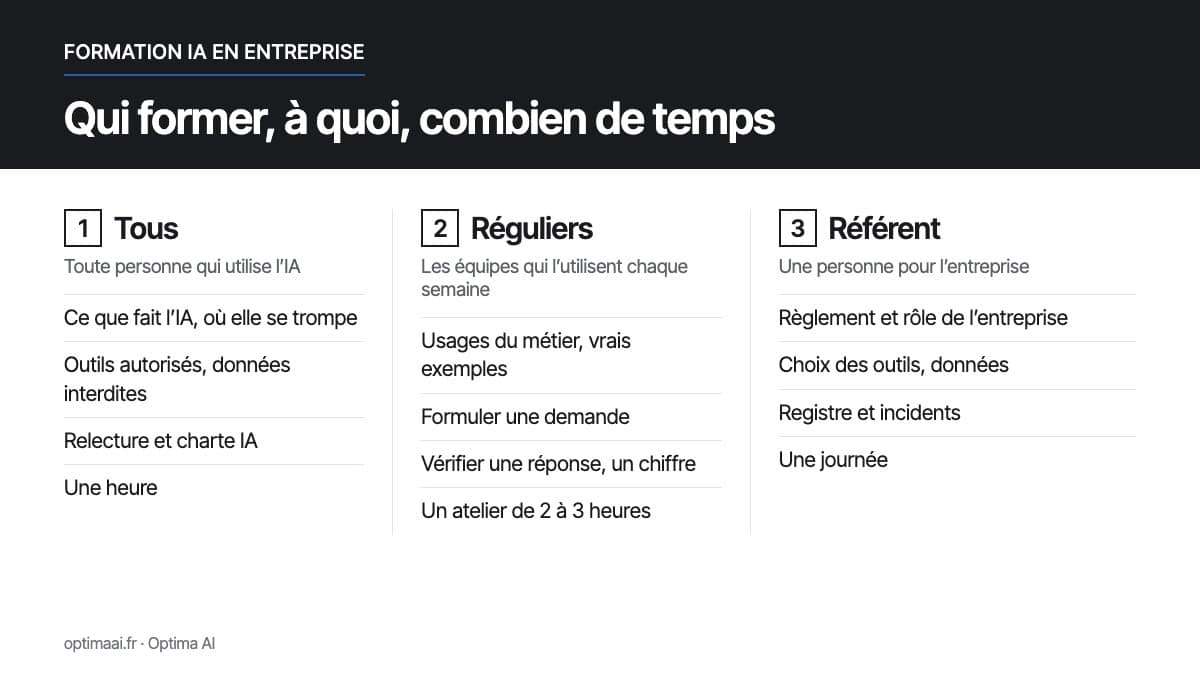
| Profile | Who | Contents | Indicative duration |
|---|---|---|---|
| All users | Any person who uses an AI tool for the company, including interns, trainees and regular contractors | What is generative AI and how it gets things wrong; allowed tools; data to never be entered; mandatory review of what goes outside; IA charter | 1 hour |
| Regular users | Teams that use AI every week in their profession: commerce, technology, administration, human resources | The practices of their profession, through their own examples; how to formulate a request; how to verify a response, a reference, a figure; the cases where AI should not decide alone | A workshop of 2 to 3 hours per team |
| AI Reference | A person, often in management or IT | European regulation and the role of the company; the choice of tools and the reading of their data usage conditions; the keeping of the register; incidents | One day, possibly with a specialized organization |
The durations are guidelines, not requirements of the text. They remain short because the training is based on real practices, not on a theoretical program.
Training internally or through an organization?
For the first two profiles, in-house training often works better: it is the person who knows the business and the tools of the company who can show, on a real document, where AI helps and where it is wrong. A training organization is especially useful for the reference person, or when no one within the company yet has enough perspective.
In both cases, include these actions in your skills development plan. For companies with fewer than 50 employees, Article L6332-1-3 of the Labor Code entrusts the skills operator (OPCO) with the responsibility for «actions contributing to the development of skills.» The conditions and amounts depend on your OPCO: ask them before choosing a paid training course.
A tip: make sure the training is followed during working hours, with examples taken from the team’s week. Integrating AI into one’s job means adopting an adaptive mindset: being curious, looking for levers to improve performance. Training that remains theoretical is of no help.
How to document AI training?
The regulation does not impose any specific document. The European Commission indicates that a company can keep an internal register of its training and other activities. This register allows you to show, when asked, that measures have been taken.
In practice: the register of AI control
- The tools : the list of AI tools used, dated (this is the annex to your AI charter).
- The people : who uses what, and to what profile each one belongs.
- The shares For each session, the date, duration, content, facilitator, medium and list of attendees.
- The evidence : marginal note, training material, accused of reading the charter.
- The updates : every new tool, every new use, every incident, with the measure taken.
A shared spreadsheet is sufficient. The essential thing is that it is kept up to date by the reference person, and reviewed on the same date as the charter.
AI training in the workplace: the 5-step plan
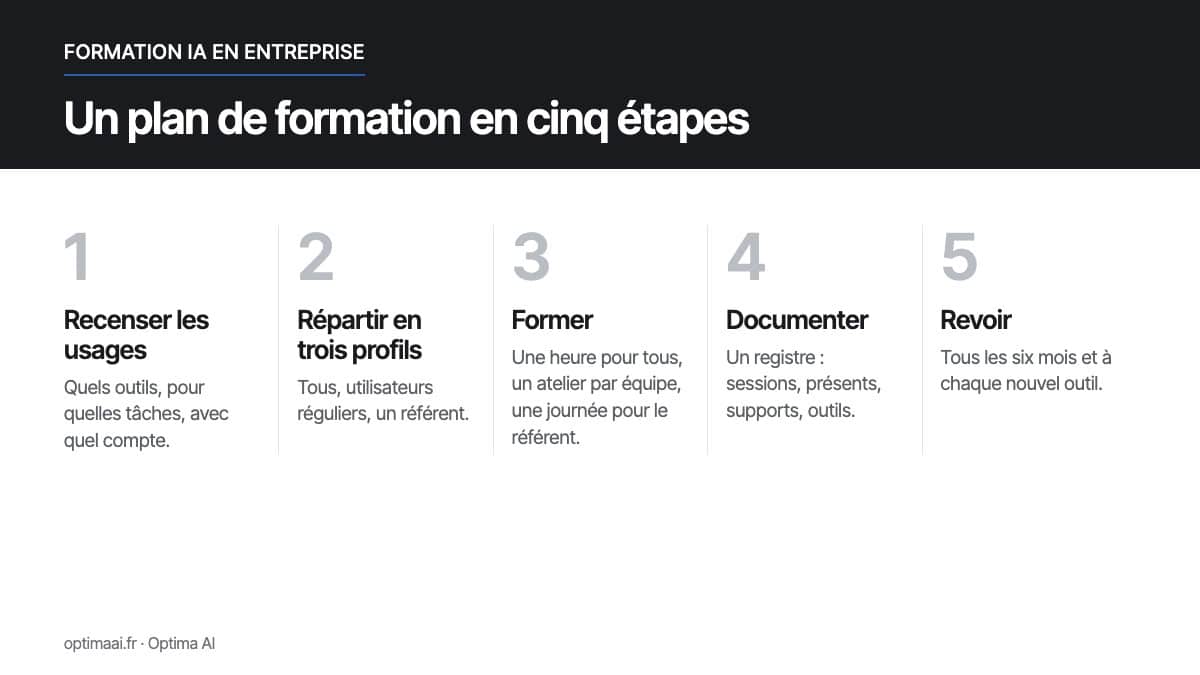
- Identifying real uses. What AI tools do your teams use, for which tasks, with a personal account or an enterprise account? An anonymous five-question questionnaire is sufficient.
- Distributing people into three profiles : all users, regular users by profession, a reference.
- Former Each profile: one hour for everyone, one workshop per team, one day for the reference person.
- Documenting in the register: sessions, attendees, materials, tools involved.
- Review every six months, And with every new tool: a short update is better than a large training session per year.
To download: the IA training kit
The five steps, ready for use: the anonymous questionnaire, the training modules, the exit sheet (Word) and the follow-up table in five tabs (Excel).
Why link training to the IA charter?
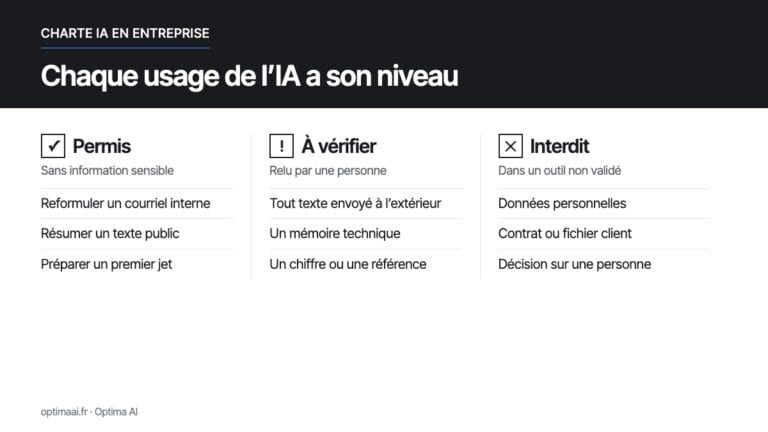
Because they answer the same question: how does the company want its teams to use AI? AI charter writes the rules (authorized tools, usage, data, review). The training explains them through examples, and the registry keeps track of both.
Order matters. Forming without a charter is explaining rules that do not yet exist. Writing a charter without presenting it is publishing a document that no one will read. In a SME, an hour-long meeting for everyone can be the presentation of the charter itself.
And after the training: a task to be entrusted to AI
The census of the first stage can also reveal something other than a need for training: a specific task that comes up every week, one that someone knows by heart and that AI could prepare. It is through a task like this that a project begins. Optima Studio : an agent, a process. The tool prepares; your expert revises, corrects, and validates.
During our webinar on October 13, 2026 with the Marne-Ardenne CCI, Mathieu Domon presented three use cases that each start with a task, not a technology. Replay « Integrating AI in your company: myth or reality?» is freely available. To choose this first task, the method is detailed in our article Integrating AI in SMEs: where to start?
Frequently asked questions
Is AI training mandatory for all companies?
Under the AI Act, not in the form of imposed training. Article 4 of the European regulation on AI, in its current wording since July 27, 2026, requires companies that provide or use AI systems to «take measures to promote the development of AI mastery» by their personnel. Appropriate training is naturally part of this, but other actions are also included. The Labour Code, for its part, requires the employer to adapt employees to their positions, including when technologies evolve (article L6321-1).
What is AI literacy?
This is the English term for AI Act, translated as «AI mastery» in the French version and defined in Article 3 of the regulation. In practice, it means knowing what an AI tool does well, where it makes mistakes, what data can be entrusted to it and when a person must verify or decide.
Is certification training in AI necessary?
No. The European Commission indicates that no certificate is required under Article 4. A certification training can serve a professional project or the IA reference, but it is not required for users.
How long should an AI training program in a company last?
The text does not set any duration. A realistic benchmark for a SME: one hour for all users, a two- to three-hour workshop per team that uses AI every week, one day for the reference person, and then a short update every six months.
Who finances the AI training of employees?
The employer, as part of its skills development plan. In companies with fewer than 50 employees, the skills operator (OPCO) may take on responsibility for skills development actions (Article L6332-1-3 of the Labour Code), according to its own conditions.
Sources
- Regulation (EU) 2024/1689 on artificial intelligence, Articles 3 and 4 (EUR-Lex)
- Regulation (EU) 2026/1744 of 8 July 2026, replacing Article 4 (EUR-Lex)
- European Commission, «AI Literacy – Questions & Answers», updated on October 20, 2026 (in English)
- Labour Code: L6321-1, L6332-1-3 (Digital Labour Code)
- CNIL, «How to deploy generative AI?»
 French
 English