

By Mathieu Domon, President of Optima AI · Updated November 13, 2026
The GDPR applies whenever an organization entrusts an artificial intelligence tool with information about an identifiable person: a CV, a customer email, an interview report. The European regulation on AI (AI Act) does not replace it; it adds to it. Therefore, before using AI on personal data, the company must set a specific goal, only include the necessary data, choose a tool governed by a contract, inform the affected individuals, and appoint a person to make decisions. No AI tool is «GDPR compliant» by nature: compliance depends on how the company uses it.
In short
- Personal data is «any information relating to an identified or identifiable natural person» (GDPR, Article 4). A name is sufficient, an email address is also sufficient.
- The provider of an online AI service that processes your data on your behalf is a subcontractor: a contract in accordance with Article 28 of the GDPR is mandatory.
- AI systems intended to sort through applications are classified as «high risk» by the AI Act (Annex III, point 4), with obligations applicable from December 2, 2027. The Labour Code already requires that the candidate be «specifically informed, prior to their implementation, of the methods and techniques of recruitment assistance used in their regard» (article L1221-8).
Does the GDPR apply when using AI?
Yes, as soon as the tool receives personal data. The GDPR does not target a technology but an treatment Collecting, consulting, transmitting, and analyzing information about a person. Inserting a customer’s email into an assistant to summarize it is transmitting their data to a third-party service.
The company that decides to use the tool, for what purpose and with what data, is the Data controller She is responsible for ensuring compliance with the GDPR.
Conversely, AI used on a technical sheet or a specification without a name does not fall under the GDPR.
What data should never be included in a public AI tool?
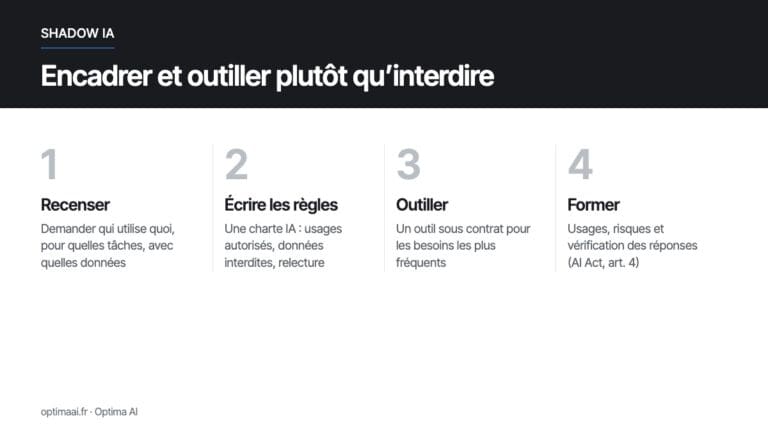
A public AI tool used with a personal account, whether free or paid, is not governed by any contract between the company and its publisher. The company does not always know where the data goes or what happens to it. The CNIL recommends regulating usage by defining a list of permitted and prohibited uses, for example «not providing personal data to the system» (CNIL, July 18, 2024). When employees use AI without telling anyone: Shadow IA.
In a tool of this type, you never know:
- the «sensitive» data» that the GDPR prohibits processing except in exceptional circumstances (article 9): health, ethnic origin, political opinions, religious beliefs, trade union membership, sexual life, biometric or genetic data. A sick leave certificate, a letter from occupational health services or a request for a post adjustment are examples of these;
- data on employees and candidates CVs, annual interviews, salaries, sanctions;
- customer data which allow them to be identified: name, contact details, content of their exchanges, order history, identification numbers.
When the task allows it, good practice is to remove the names and identifying details before submitting the text. Note: replacing a name with an initial is not always sufficient; if the rest of the text allows the person to be identified, the GDPR continues to apply only when the person can no longer be identified by means that are reasonably likely to be used (consideration 26).
These rules deserve to be written down: that is one of the roles of a AI charter in the workplace.
Is the AI provider a subcontractor within the meaning of the GDPR?
Most often, yes. When an online AI service processes personal data on behalf of from the company, on its instructions, he is its subcontractor.
The company may only engage subcontractors «who present sufficient guarantees» (Article 28, paragraph 1), bound by a contract that obliges them, among other things, to process the data «only on documented instruction from the controller» (Article 28, paragraph 3).
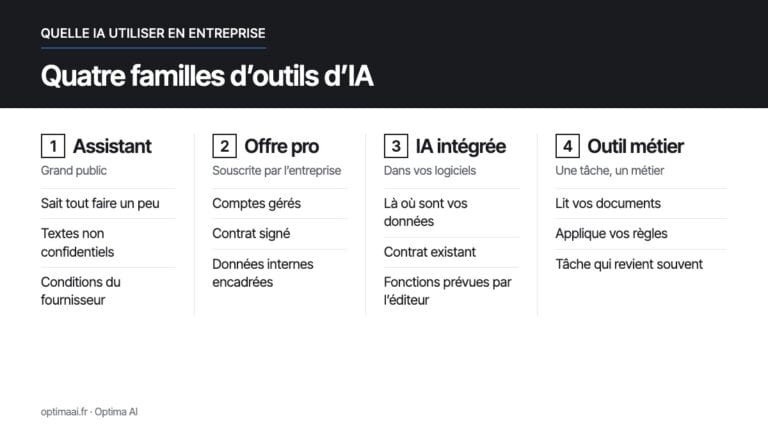
In practice, before choosing an AI tool for personal data, ask the publisher for their consent to process the data and check three points: can the publisher reuse your data for its own purposes? How long do they keep it for? Does it use other subcontractors? A personal account does not have this option. To compare the different tools, see Which AI should be used in the company.
If the data are being transferred outside the European Union, the transfer must comply with Chapter V of the GDPR, «including for subsequent transfers» (Article 44): a decision on adequacy by the Commission (Article 45) or appropriate safeguards, such as the standard data protection clauses adopted by the Commission (Article 46). The contract must govern these transfers (Article 28, paragraph 3, a): ask where the data are being processed.
Is an impact analysis (AIPD) required before using AI?
Not for every use. Article 35 of the GDPR requires an impact assessment regarding data protection «when a type of processing, in particular through the use of new technologies […] is likely to create a high risk to the rights and freedoms of natural persons.» It is carried out «before the processing.».
The same article requires it in particular for the «systematic and in-depth assessment of personal aspects» based on automated processing and used to make decisions that affect individuals, and for the «large-scale» processing of sensitive data (Article 35, paragraph 3).
The CNIL has published the list of processing operations for which it is required (article 35, paragraph 4; deliberation no. 2018-327 of October 11, 2018). It includes the processing operations that establish profiles of individuals for the purpose of human resources management, with an example being the processing «aimed at facilitating recruitment, notably through a selection algorithm». Summarizing an internal report without naming the person does not require an impact analysis. If the company has appointed a data protection officer (DPO), it asks him/her for advice (article 35, paragraph 2).
Should people whose data passes through AI be informed?
Yes. When an organization collects data, it must indicate to the individuals, among other things, «the purposes of the processing to which the personal data are intended, as well as the legal basis for the processing,» the recipients of the data, and the possible transfer outside the Union (article 13). If an AI tool processes applications or customer messages, the information must be mentioned: it is a new recipient, sometimes a new purpose, which must then be compatible with the first (article 6, paragraph 4) or based on its own legal basis.
The use must also be based on one of the six legal bases of Article 6, often the performance of a contract or the legitimate interest in business, chosen and documented before starting (Article 5, paragraph 2). The register of processing activities (Article 30), on the other hand, mentions the purpose and the categories of recipients: the new tool is included in this.
In companies with at least fifty employees, the social and economic committee is also informed and consulted on the «introduction of new technologies» (Article L2312-8 of the Labor Code): an AI tool deployed among the teams is most often used to monitor this.
Can an AI make a decision about a person on its own?
In principle, no, when the decision matters to them. Article 22 of the GDPR gives everyone the right «not to be subject to a decision based exclusively on automated processing, including profiling, which produces legal effects concerning or significantly affecting them in a similar manner.» Refusing a candidacy, a credit, or a contract based solely on an AI score falls into this category.
The exceptions are narrow: contract, law, explicit consent. For the contract and consent, the company must provide at least the right to obtain human intervention, to express one’s point of view and to challenge the decision (article 22, paragraph 3); for the law, it is the law that sets the guarantees. The practical rule is simple: the AI prepares, a person decides, with the real power to not follow the proposal.
How do the GDPR and the AI Act interact?
The two texts apply together. The GDPR protects the people whose data is being processed, regardless of the tool; the AI Act regulates AI systems according to their level of risk, and calls the company that uses them a «deployer».
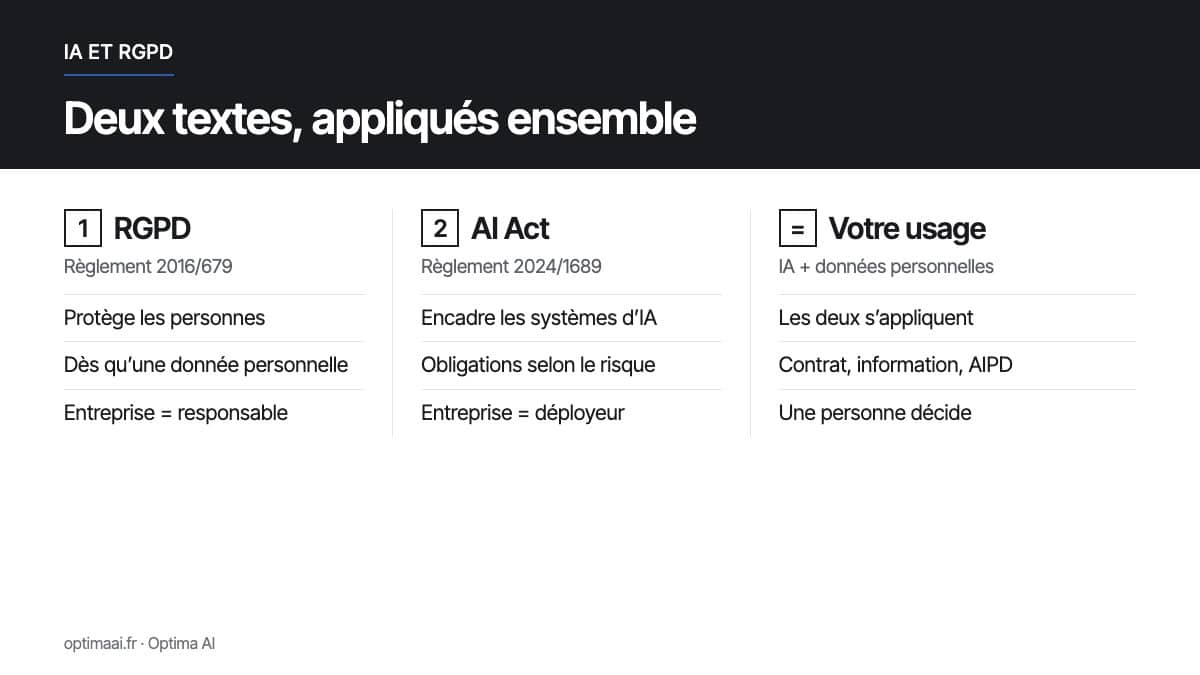
The AI Act specifies that it has no impact on the GDPR, subject to two limited exceptions (Article 2, paragraph 7, in its wording resulting from Regulation (EU) 2026/1744).
Training teams in these reflexes also complies with Article 4 of the AI Act on the control of AI: see Training in AI and AI Act.
Example: an SME that wants to summarize CVs and customer emails
Let’s take a fictitious SME. The human resources manager would like a summary of each CV received; the customer service department would like a summary of the morning emails.
The CVs. If the tool classifies or filters applications, it falls within the high-risk uses of the AI Act, which targets systems intended to «analyze and filter applications and evaluate candidates» (Annex III, point 4, a). The obligations of the deployer of such a system, including the information of candidates (article 26, paragraph 11), apply from December 2, 2027 (article 113, as amended by Regulation 2026/1744). The GDPR and article L1221-8 of the Labor Code, on the other hand, apply today. The SME therefore chooses a tool under contract, informs the candidates in the announcement, conducts an impact analysis if the tool evaluates or sorts applications, and keeps the decision to invite or not in the hands of the HR manager. It does not upload any CV into a general-purpose tool. Attention: if it turns a general-purpose tool into a tool for sorting applications, AI Act can then treat the company as a high-risk system provider, with more stringent obligations (Article 25, paragraph 1 c).
The customer emails. An integrated tool in the messaging system is suitable, provided that its contract provides for processing on behalf of the company; messages containing health data are excluded, and the information mentions the new recipient.
Using AI in your own processes
Optima Studio is Optima AI’s bespoke offering: for a process that takes time for your teams, we design an AI agent, or a simple software when a rule is sufficient. An agent, a process. The documents of an Optima Studio project are never accessible to another client and are not used to train an AI model, including the files shown during the exchange and the framing. If a commercially available software already does the job, or if no tool would change anything about it, we tell you that from the very beginning of the exchange.
This article provides a general framework; it does not replace the advice of your DPO or a lawyer regarding your situation.
Frequently asked questions
Is there an AI that complies with the GDPR?
No official label declares an AI tool to be «GDPR compliant». An AI tool can offer good guarantees, such as a subcontracting contract; compliance then depends on the use: data entrusted, purpose, information, human decision.
Should candidates be informed if AI helps with recruitment?
Yes. The candidate must be «specifically informed, prior to their implementation, of the methods and techniques of recruitment assistance used against them» (Article L1221-8 of the Labour Code), and the GDPR information notice cites the tool (Article 13). The methods used must also be «relevant in light of the intended purpose».
What risks does a company that does not comply with the GDPR faces when using AI?
The same sanctions as for any other treatment: the CNIL can, in particular, remind the company to comply with the rules, order it to bring the treatment into compliance, or impose an administrative fine, depending on the severity of the breach (Articles 58 and 83 of the GDPR).
Sources
- Regulation (EU) 2016/679, GDPR Considering 26, Articles 4, 5, 6, 9, 13, 22, 28, 30, 35, 44 to 46, 58, 83 (EUR-Lex)
- Regulation (EU) 2024/1689 on artificial intelligence, consolidated text of July 27, 2026 Article 2, paragraph 7, Article 4, Article 25, paragraph 1, Article 26, paragraphs 9 and 11, Article 113, Annex III (EUR-Lex)
- Regulation (EU) 2026/1744 of 8 July 2026, omnibus digital on AI (EUR-Lex)
- CNIL, « How to deploy generative AI? The CNIL provides initial details », July 18, 2024
- CNIL, «AI: How to comply with the GDPR?», April 5, 2022
- CNIL, List of types of processing operations for which an impact analysis is required (Decision No. 2018-327 of October 11, 2018)
- Labour Code: L1221-8, L2312-8 (Digital Labour Code)
 French
 English