
By Mathieu Domon, President of Optima AI · Updated November 19, 2026
Shadow AI, or ghost AI, refers to the use of artificial intelligence tools by employees for their work, without the company having planned or supervised it. It almost always arises from a real need: to save time on an email, a report, or a translation. The risk does not come from the AI itself, but from what circulates without control: personal data, confidential information, unverified responses. The effective response is not to ban, but to regulate and equip: identify the uses, write rules, provide contract-based tools, and train the teams.
In short
- Shadow AI is a form of «shadow IT»: the use of tools in the workplace that the company has neither chosen nor overseen. With generative AI, all it takes is a browser and a few minutes.
- Banning without offering an alternative moves the problem: the use continues, but on personal accounts and without anyone seeing it.
- An enterprise that uses an AI system «under its own authority» is a «deployer» within the meaning of the AI Act (article 3, point 4); article 4 requires it to take measures to foster the mastery of AI by its personnel. Encasement of the use also means bringing it under that authority.
What is shadow AI?
The shadow IA (from the English shadow AI) is the use, by employees, of artificial intelligence tools that the company has not validated: an open public conversational assistant with a personal account, a browser extension that summarizes pages, an online service for translating or transcribing meetings.
The expression takes up the expression of shadow IT, which has long been synonymous with software and services used outside the framework set by the IT department. The difference lies in the ease of use: a generative AI tool requires neither installation, nor budget, nor technical expertise. You copy a text, and you get a response.
Shadow AI is not a marginal or malicious behavior. It is most often a well-intentioned employee who is trying to do their job better, in a company where no one has told them what is allowed.
Why do employees use AI without saying so?
Because the tool meets an immediate need, and the rule does not exist or is not known. Almost always the same reasons are found:
- Visible time savings in repetitive tasks: restating a letter, summarizing a long document, preparing a first draft of a report;
- the absence of a clear rule without any guidelines, everyone decides for themselves what is acceptable;
- the absence of the provided tool If the company offers nothing, the employee takes what he finds;
- the fear of being judged Some people keep quiet about their use of it for fear that their work will appear less personal, or that they will be blamed for it.
The shadow IA is therefore also a useful signal. It shows where the tasks that take time from the teams are located, and therefore where AI could serve the company if it were properly used.
What are the risks of shadow AI for the company?
They can be grouped into four families.
Personal data. Placing a customer’s email or CV in a public tool means transmitting this data to a third-party service with which the company has not signed any contract. When a service processes data on behalf of the company, the GDPR requires the selection of subcontractors «who present sufficient guarantees» (Article 28, paragraph 1), bound by a contract. With a personal account, this contract does not exist between the company and the publisher. The details of the obligations are explained in our article. AI and GDPR.
Confidential information. A price given to a client, a plan for a room, an answer to a tender, a contract under negotiation: this information is often covered by confidentiality clauses or falls within the company’s expertise. Once captured in an unmanaged tool, the company no longer knows where it is stored or how it is reused.
The quality. A generative AI can produce a False answer with a lot of assurance. If no one knows that a text has been prepared by an AI, no one thinks to check it with the necessary attention.
Traceability. Without an inventory, the company does not know which tools are used, by whom, for which tasks, and with what data. It cannot either correct a mistake at the source or answer a customer or an authority who questions it.
Should generative AI be banned at work?
A general ban, without alternatives, rarely has the desired effect. The need remains; usage shifts to personal phones or at home, and becomes even less visible. The company also loses the benefit of what its teams have learned.
For organizations deploying generative AI, the CNIL recommends starting with a concrete need, then ’encourage usage by defining a list of permitted and prohibited uses,« for example »not providing personal data to the system, or not delegating decision-making« (CNIL, July 18, 2024). It also recommends training and educating users »both regarding prohibited uses and the risks involved in permitted uses.«.
Banning certain uses, yes; banning AI, no.
How to identify AI uses in your company?
Before monitoring, ask questions. The simplest way is a short anonymous questionnaire or a service exchange, which asks three questions: for which tasks do you use an AI tool, which with which information? Clearly state that the goal is to understand the needs, and that what is stated in this context will not be held against you.
The answers provide a map of usage: the tasks that recur, the data that flows, the tools already adopted. This is the starting point for rules and the choice of tools.
If the company plans a technical control (filtering, recording of the sites visited), two rules of the Labour Code apply. «No information concerning an employee personally may be collected by a device that has not been brought to their knowledge beforehand» (article L1222-4). And in companies with at least fifty employees, the Works Council is also informed and consulted, before the decision, on the means of monitoring the activity of employees (article L2312-38). The GDPR also applies to this data.
If the census reveals that personal data has already been entered into an instrument without a contract, failure to hold the employee accountable does not exempt the company from examining whether it constitutes a data breach (GDPR, Article 4, point 12); the company must notify the CNIL, if possible within 72 hours, unless it is likely to pose a risk to individuals (Article 33).
How to regulate the use of AI by employees?
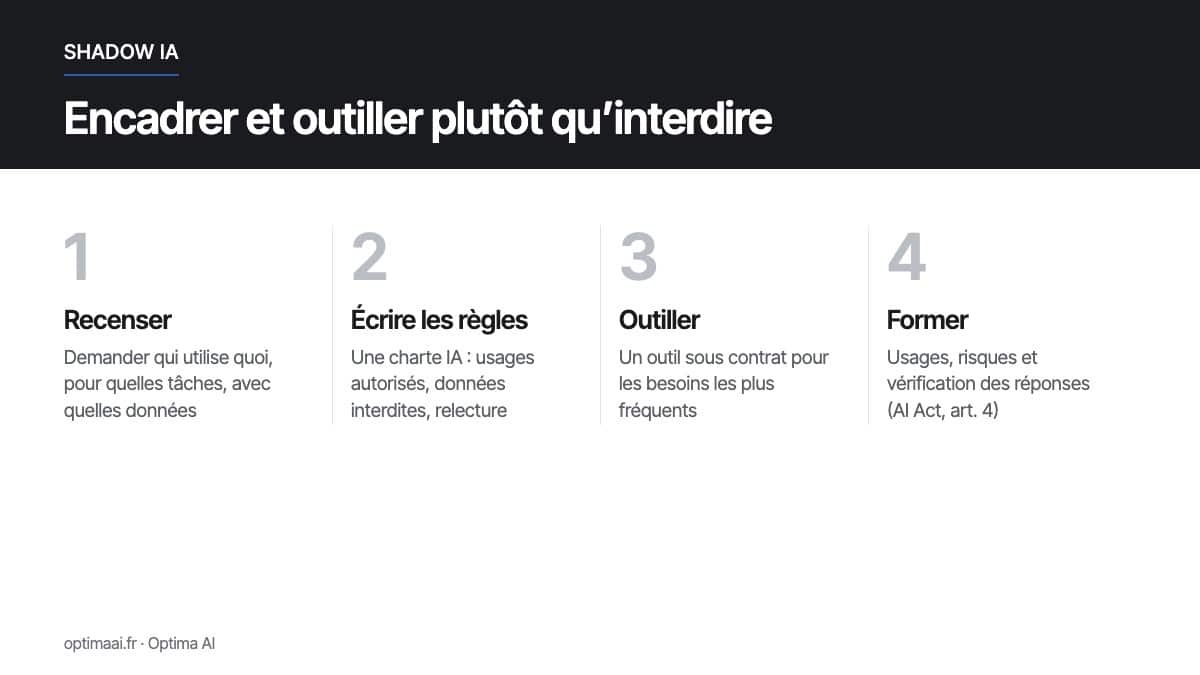
Once the practices have been identified, three actions are required: writing the rules, providing tools, and training. In companies with at least fifty employees, the consultation of the works council is also required.
Writing the rules in an IA charter
The charter states what is allowed, what is prohibited, and who can ask a question: authorized tools, data never to be accessed, mandatory human verification. We detail its content and its implementation in AI charter in the workplace: why write one, and what to put in it.
Its form matters. While the charter sets out general and permanent obligations regarding health, safety, and discipline, it follows the rules of the internal regulations, whether the company has one or not (Article L1321-5 of the Labor Code): opinion of the social and economic committee if one exists, filing with the registry of the labor council (Article R1321-2), notification to the labor inspection, entry into force one month after the publicity formalities (Article L1321-4). Have your lawyer verify this point before distributing the charter.
Providing contracted tools
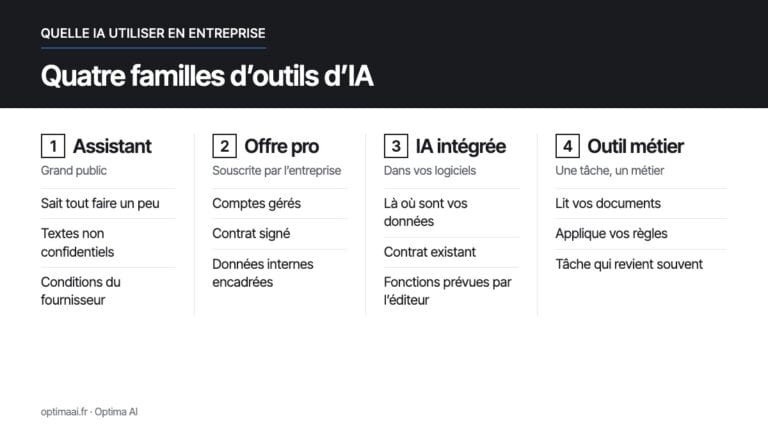
A rule without tools is not enough. Offer at least one validated solution for the most common needs, with a contract that governs the processing of data and specifies whether the publisher can reuse it. To compare the tool families, see Which AI should be used in the company.
Training the teams
Article 4 of the AI Act applies since February 2, 2025. In its wording derived from Regulation (EU) 2026/1744, it provides that suppliers and deployers «take measures to foster the development of AI mastery by their personnel.» Training means explaining the permitted uses, the risks, and verifying responses: see Training in AI and AI Act.
Consult the CSE
In companies with at least fifty employees, the social and economic committee is informed and consulted on «the introduction of new technologies» (Article L2312-8 of the Labour Code). The deployment of AI tools among the teams is most often the result of this; it is also an opportunity to explain the approach.
Example: A SME that discovers its hidden uses
Let’s take a fictitious industrial SME. In preparing its charter, the management interviews each department. It discovers that the commercial department reworks its offers with a general public assistant, prices offered to customers included; that the design office has notices translated by an online service; that the management secretariat summarizes the meeting minutes.
None of these uses is absurd. The management rejects the idea and changes the framework: prices and customer data are no longer stored in a tool without a contract; a validated tool is proposed for reformulation and translation; each text prepared by AI is reviewed by the person who signs it. The charter writes these rules, a short training explains them. And the sales department, which used to spend the most time on its offers, becomes the first candidate for a tool designed for this task.
Replacing hidden usage with an appropriate tool
The census can reveal a task that an entire team is already secretly entrusting to a general-audience tool. Three signs indicate that it deserves a tool of its own: nothing matches on the market, it isn’t written anywhere, and it comes up often. This is the terrain of’Optima Studio, Optima AI’s custom offer: we design an AI agent for this process, or a simple software when a rule is sufficient. The 30-minute exchange and the framing are free, and the project documents are never accessible to another client or used to train an AI model. If a software on the market already does the job, we tell you about it.
This article provides a general framework; it does not replace the advice of your legal advisor or your DPO regarding your situation.
Frequently asked questions
Is shadow AI illegal?
Using an AI tool at work is not illegal in itself. It is certain uses that pose problems: entering personal data into a tool with which the company does not have a subcontracting contract (GDPR, Article 28), disclosing information covered by a confidentiality clause, or violating an internal rule that has already been brought to the attention of employees.
Can an employee be sanctioned for using AI without permission?
Yes, if the use violates a rule brought to the employee’s attention, or if it constitutes a fault in itself, for example the disclosure of confidential information. In companies that must have one, the internal regulations set out the nature and scale of sanctions (Article L1321-1 of the Labor Code). Without a written rule, a sanction is difficult to justify; without an authorized tool, it has little chance of stopping the use. For a specific case, ask for the advice of a lawyer.
How can employees know which AI tools are being used?
The most reliable way is to ask them for it, through a short anonymous questionnaire or a service exchange, specifying that the objective is to understand the needs. Any technical device that collects information about an employee must have been made known to them beforehand (Article L1222-4 of the Labour Code).
Sources
- Regulation (EU) 2024/1689 on artificial intelligence, consolidated text of July 27, 2026 Article 3, point 4, Article 4, Article 113 (EUR-Lex)
- Regulation (EU) 2026/1744 of 8 July 2026, omnibus digital on AI (EUR-Lex)
- Regulation (EU) 2016/679, GDPR Article 4, point 12, Articles 28 and 33 (EUR-Lex)
- CNIL, « How to deploy generative AI? The CNIL provides initial details », July 18, 2024
- Labour Code: L1222-4, L1321-1, L1321-4, L1321-5, R1321-2, L2312-8, L2312-38 (Digital Labour Code)
 French
 English