
Machine shutdown is the set of operations that render the machine inoperable before an intervention: it is disconnected from all its energy sources, the separation devices are deactivated, the remaining energy is evacuated, and it is verified that no restart is possible during the entire intervention. No text defines the assignment of a machine: the term comes from practice, and the Labour Code only uses it in its literal sense for electrical installations (articles R4544-4 and R4544-5). Without using the term, Regulation (EU) 2023/1230 on machinery, applicable as of January 20, 2027, requires the manufacturer to provide means to separate the machine from its energy sources (Annex III, section 1.6.3); the Labour Code requires the employer to prevent any unexpected restart before maintenance work (article R4323-15).
In short
- Four actions to document: separate, condemn, dispel, verify; then, finally, declassify.
- All energy is involved, not just electricity: hydraulic, pneumatic, mechanical, thermal, gravitational.
- The manufacturer provides the means (lockable separation devices, energy evacuation systems); the employer organizes the storage and trains those who perform it.
What the texts say
On the manufacturer's side: Regulation (EU) 2023/1230
Annex III, section 1.6.3, «Separation of the machine from its energy sources», requires that machines be equipped with «devices that allow them to be isolated from all energy sources». These devices are «clearly identified». They are «lockable if reconnection risks presenting a danger to persons», and also when the operator cannot verify from all locations to which he has access that the power is still disconnected. After the disconnection, «any residual energy or stored energy in the circuits of the machine or the related product may be discharged normally, without risk to persons». The text allows for an exception: «Certain circuits may remain connected to their energy source in order to enable, for example, the maintenance of parts, the backup of information, the illumination of interior parts, etc. In this case, special provisions are taken to ensure the safety of the operators.»
The instruction manual describes the adjustment and maintenance operations and the «instructions designed to ensure that the adjustment and maintenance can be carried out safely, including the protective measures to be taken during these operations» (section 1.7.4.2, points r and s). Directive 2006/42/EC, which applies until 19 January 2027, imposed the same requirement in the same section.
On the employer side: the Labour Code
- No maintenance on moving parts: «Prior to the execution of such work, all measures are taken to prevent the unexpected reactivation» of equipment (article R4323-15).
- For work equipment that was not subject to any design rule when it was first placed on the market, the chapter of the Labour Code that is dedicated to it also provides for «clearly identifiable and easily accessible» devices that allow them to be isolated from each of their sources of energy supply (article R4324-18); operators must be able to «ensure this separation» (article R4324-19), and the dissipation of the accumulated energy must be «easily accomplished» (article R4324-20).
- For electrical installations, the word appears in its literal form: the part of the installation that is being worked on without power «must be previously identified and recorded,» and the voltage is restored «only after the installation has been decommissioned» (article R4544-5).
Record in four gestures, then unrecord
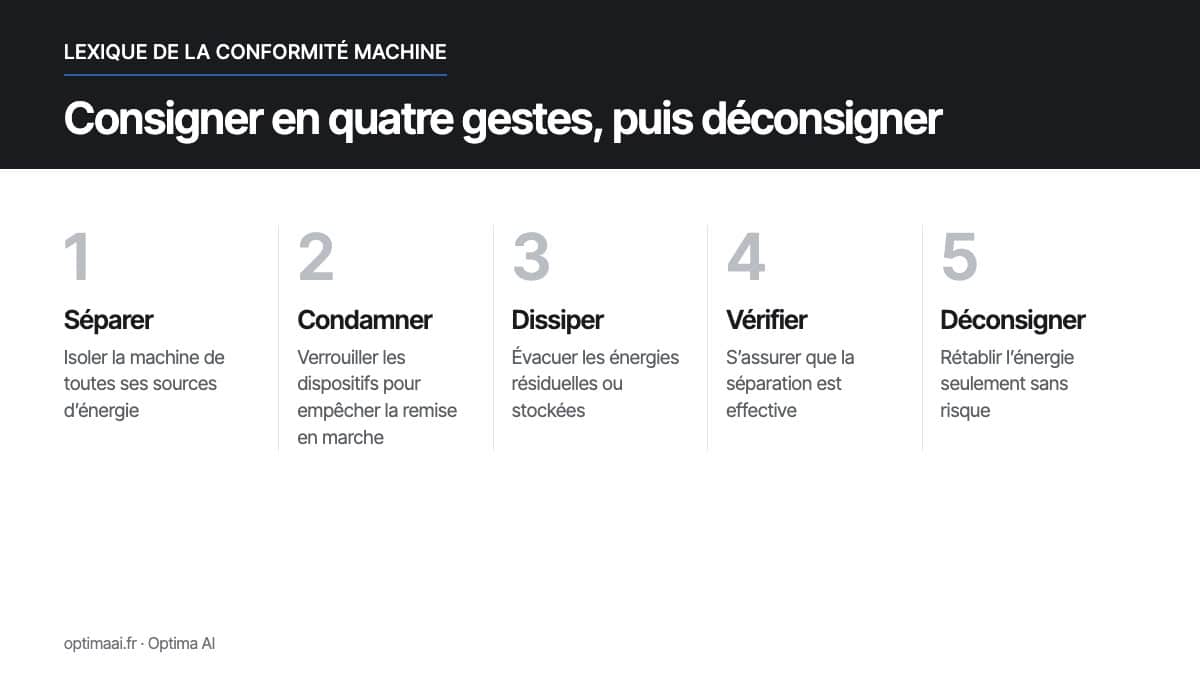
- Separate the machinery of each of its energy sources, with the devices provided for that purpose.
- Condemning these devices, for example with a personal lock, so that no one can rearm them during the intervention, and report it.
- Dissipate the remaining energies: pressure in a lever, compressed spring, inertia flywheel, suspended load, hot part.
- Check that the separation is effective before starting.
- Declaring At the end, when the intervention is finished, the protective measures are put back in place and the people are removed from the dangerous area.
What this changes for the manufacturer, integrator and operator
For the manufacturer
He designs the machine so that it can be stored: a device for separating energy sources, identified and lockable, and a means of discharging stored energy. He describes in the manual how to perform each adjustment and maintenance operation.
For the integrator
On a line, the integrator specifies what each separation device cuts and what it does not cut. A general circuit breaker that leaves a pneumatic supply or a neighboring machine running must be known to the person intervening.
For the operator
The employer writes the procedure for recording each machine, designates the people who carry it out and trains them: maintenance workers receive specific training «on the conditions for carrying out the work» (article R4323-4). He summarizes the essentials in the instructions at the station, for example in the safety sheet at the station. When an external company intervenes, the safety instructions are communicated to them (article R4512-4).
An example
A mechanic must change a tool on a hydraulic press. He lowers the slide to the lowest position on the plates provided by the manufacturer, then opens and locks the electric sectioner, closes and locks the pneumatic feed valve on the coupling, and clears the circuit, and clears the hydraulic accumulator. He places his sign, keeps the key to his padlock, then attempts to start the engine from the control panel to check that nothing is moving. He then opens the protective cover and changes the tool. At the end, he puts the protective cover back in place, checks that no one is in the area, removes the padlock, and makes a test run. This example is fictitious and simplified: the actual procedure is that of the manual and the company’s instructions.
Common mistakes
- Record only the electricity by forgetting compressed air, hydraulics, or a load that can fall down by gravity.
- Confusing arrest and detention A stop button, even an emergency stop button, does not guarantee that another person will not restart the machine.
- Skipping the verification : An incorrectly identified circuit breaker can cut off another machine other than the one being worked on.
- Restarting without control After a maintenance operation that required the removal of protective covers, an inspection checks that they are in place and functioning (article R4323-14).
Consignment and emergency arrest: what difference?
The’emergency stop Used to quickly stop a machine in a dangerous situation; the stop order is maintained, but the machine remains connected to its energy sources and anyone can re-energize it. The logging prepares a planned intervention: the machine is separated from its energy sources; the separation is confirmed and verified. Emergency stops are not logged.
Related words: emergency stop, residual risk, Intrinsic prevention, Essential health and safety requirements, notice of instructions, method of operation.
Frequently asked questions
Who has the right to register a machine?
The persons designated and trained by the employer. The Labour Code reserves certain maintenance work for workers assigned to it and provides for specific training for them (articles R4323-15, R4323-17 and R4323-4). For electrical installations, these operations are reserved for qualified workers (article R4544-9); the authorization is issued by the employer (article R4544-10).
Should it be recorded for a simple cleaning?
The Labour Code imposes a result, not the word: before a cleaning, degreasing, lubrication or adjustment is carried out while the machine is stopped, «all measures are taken to prevent the unexpected start-up» (article R4323-15). Recording is the safest way to achieve this. If a job cannot technically be carried out while the machine is stopped, special provisions are made and the employer writes down an instruction.
Which standard deals with consignation?
For machines, the standard EN ISO 14118, Machine safety — Prevention of untimely start-up ; For electricity, the standard is NF C 18-510. The obligations themselves come from Regulation 2023/1230 and the Labour Code.
Sources
- Regulation (EU) 2023/1230 on machinery, consolidated text of 27 July 2026 Annex III, sections 1.6.3 and 1.7.4.2 (EUR-Lex)
- Directive 2006/42/CE on machinery Annex I, section 1.6.3 (EUR-Lex)
- Labour Code: R4323-4, R4323-14, R4323-15, R4323-17, R4324-18 to R4324-20, R4512-4, R4544-4, R4544-5, R4544-9, R4544-10 (Digital Labour Code; title of Chapter R4324 as read on Légifrance)
- EN ISO 14118, Machine safety — Prevention of untimely start-up ; NF C 18-510, Operations on electrical works and installations and in an electrical environment — Prevention of electrical risk (titles only; text paid for)
Updated definition as of November 13, 2026. It does not replace the reading of the official text. Find our articles on the documentation machine.
By Philippe, regulatory expert at Optima AI. Are your recording procedures included in your notices and safety data sheets at the station? Optima Compliance, Our machine compliance offering helps you to write, control and maintain the documentation of your machines using your own documents.
 French
 English