
Intrinsic prevention refers to the design and construction choices of a machine that eliminate a hazard or, if that is not possible, reduce the risk at its source, without adding a protective device or relying on the operator’s behavior. Regulation (EU) 2023/1230 on machinery, applicable from 20 January 2027, constitutes the first mandatory step in reducing risk: it talks about «intrinsically safe design and construction» (Annex III, section 1.1.2, point b).
In short
- Three steps, in the indicated order: design to be secure, then protect, then inform. Inherent prevention is the first step.
- It acts on the machine itself: forms, energies, speeds, forces, materials, and the location of the points of intervention.
- The manufacturer must be able to show that they have researched it before placing a protector or pictogram.
What the text says
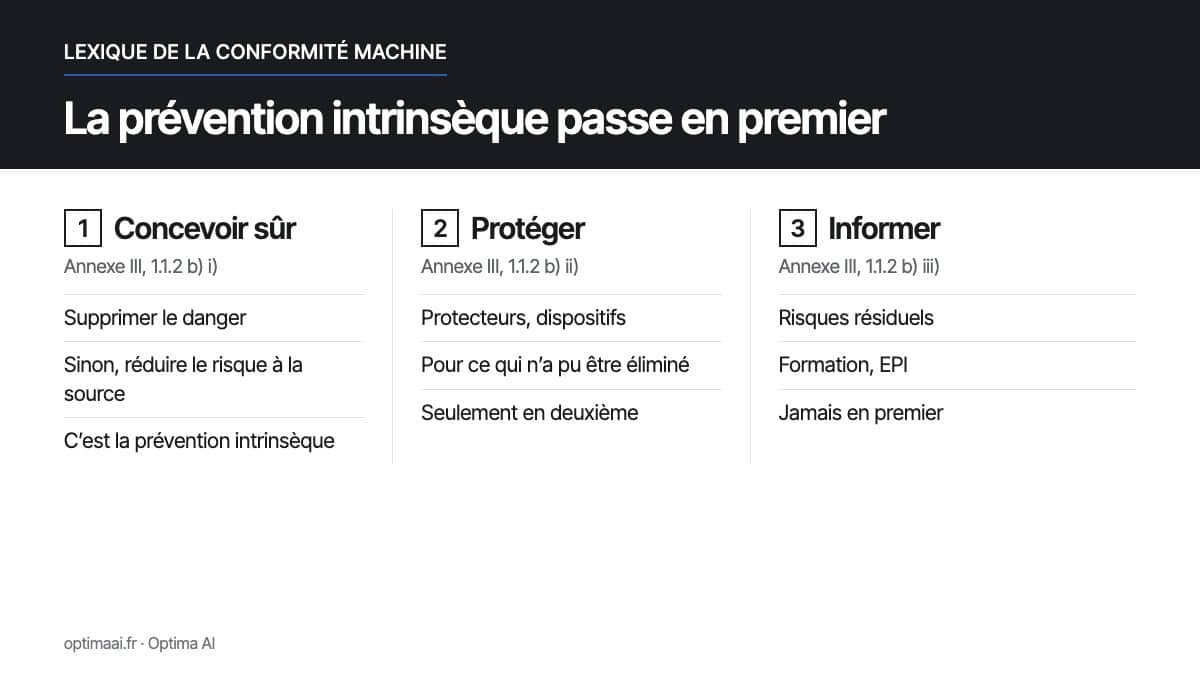
Annex III to Regulation (EU) 2023/1230, section 1.1.2, point b, requires the manufacturer, «choosing the most appropriate solutions», to apply three principles «in the indicated order»:
- « eliminate the dangers or, if this is not possible, minimize the risks (inherently safe design and construction of the machine or related product) »;
- « taking the necessary protective measures regarding risks that cannot be eliminated » ;
- « inform users of the residual risks due to the incomplete effectiveness of the protective measures adopted, indicate whether specific training is required and indicate whether it is necessary to provide for individual protective equipment ».
The general principles of the same annex refer to this order of priority: the manufacturer «eliminates the hazards or reduces the risks associated with these hazards by applying protective measures, in accordance with the order of priority established in section 1.1.2, point b)» (part B, point 1, e). And these principles of safety integration apply «in all cases» (part B, point 2), including in the case of quasi-machines (section 1.1.1).
The term «intrinsic prevention» is that of risk assessment practitioners; the regulation, on the other hand, states «intrinsically safe design and construction.» Both designate the same stage. Directive 2006/42/EC, which applies until January 19, 2027, already laid down the same order, speaking of ’integration of safety into the design and construction of the machine« (Annex I, section 1.1.2).
What this changes for the manufacturer, integrator and operator
For the manufacturer
For every hazard identified in the risk assessment, the manufacturer first asks itself the question: can it be eliminated or reduced by changing the machine? Reduce energy, speed, or effort; round off an edge; move a lubrication point away from the hazardous area; choose a material that does not shatter into fragments. Only then does it move on to protective devices and safeguards, and then to information. The technical documentation must record this reasoning.
For the integrator
The integrator that assembles several machines in line takes this approach on a whole-system basis: installation, height of workstations, access points for adjustment and cleaning. What he can adjust through the layout often avoids the need for an additional protector.
For the operator
The employer applies a similar reasoning to its workplaces: the Labor Code requires it to first ’avoid risks,« »combat risks at their source,« and »replace what is dangerous with what is not dangerous or less dangerous« (article L4121-2). When buying or modifying a machine, that is also what it looks at.
An example
On a belt conveyor, the point of return between the belt and the drum can catch a hand. Intrinsic prevention: eliminate the return points that are not essential, reduce the belt speed to the strict minimum, and move the lubrication and adjustment points away from the drum area, so that they do not have to be touched by hand. There remains a risk of being caught near the drum: this is then dealt with by a fixed protector, and the remaining risks are then reported in the manual and on the machine. This example is fictitious and simplified.
Common mistakes
- Start with the protector : installing a casing without asking whether the danger could be eliminated. The order of section 1.1.2 is mandatory.
- Confusing intrinsic prevention with reliability A robust machine is not necessarily safe by design if the danger remains accessible.
- Not to write anything The procedure does not appear in the risk assessment or in the technical documentation, and the manufacturer can no longer show it.
Intrinsic prevention and protective measure: what difference?
Intrinsic prevention changes the machine so that the danger no longer exists, or is reduced. The protective measure keeps the danger in place but prevents access to it: the regulation defines the protector as an «element of the machine or related product used specifically to provide protection through a material barrier», and the protective device as a «device (other than a protector) that reduces the risk, alone or in association with a protector» (Annex III, Part A). What remains after the two is residual risk.
Related terms: risk reduction, protector, protective device, residual risk, substantial modification, risk assessment (see our article Machine risk analysis according to ISO 12100).
Frequently asked questions
What is an intrinsic preventive measure?
This is a measure taken at the very design of the machine to eliminate a danger or reduce the risk at its source: less energy, a lower speed, limited effort, a shape without shear points, a setting point placed outside the dangerous zone.
Is intrinsic prevention mandatory?
Yes. Regulation (EU) 2023/1230 requires the manufacturer to eliminate hazards or minimize risks through design before resorting to protective measures, and then to information (Annex III, section 1.1.2, point b). These principles apply in all cases, including for quasi-machines.
Is a danger pictogram an intrinsic preventive measure?
No. A pictogram indicates the existence of a risk that remains: it falls under the third stage. It cannot replace a design or protective measure that was possible.
Sources
- Regulation (EU) 2023/1230 on machinery, consolidated text of 27 July 2026 Annex III, Part A, Part B (points 1 and 2), sections 1.1.1 and 1.1.2 (EUR-Lex)
- Directive 2006/42/CE on machinery Annex I, section 1.1.2 (EUR-Lex)
- Labour Code: L4121-2 (Digital Labour Code)
- EN ISO 12100, Machine safety — General design principles — Risk assessment and risk reduction (title only; text paid for)
Updated definition as of November 13, 2026. It does not replace the reading of the official text. Find our articles on the documentation machine.
By Philippe, regulatory expert at Optima AI. Does your documentation keep track of your design choices? Optima Compliance, Our machine compliance offering helps you to write, control and maintain the documentation of your machines using your own documents.
 French
 English