
By Mathieu Domon, President of Optima AI · Updated November 5, 2026
AI helps to respond to a tender, especially where there is a need to read and collate a large amount of text: classifying the DCE documents, identifying the criteria for judging, preparing a first draft of the technical report based on your documents, checking that no documents are missing. It does not decide to proceed, does not set your prices, and does not replace the review process: the answer remains yours, and you are the one who signs it. Here is, step by step, what AI does well, what it does badly, and what remains within your control.
In short
- An answer to a tender process involves six steps: reading the tender documents, deciding to go ahead, asking questions, writing the tender dossier, gathering the documents and calculating the costs, and rereading the document.
- AI saves you time when reading the file and when writing the first draft of your paper, provided you work from your own documents.
- She is especially wrong when she invents: a reference, a means, a time limit that you do not have. Every written commitment must be true.
- The public procurement rules cited here concern the submitted offer, not the way it is prepared: the company remains responsible for what it submits. Check what the consultation documents stipulate, particularly regarding confidentiality.
What AI changes in the response to a tender
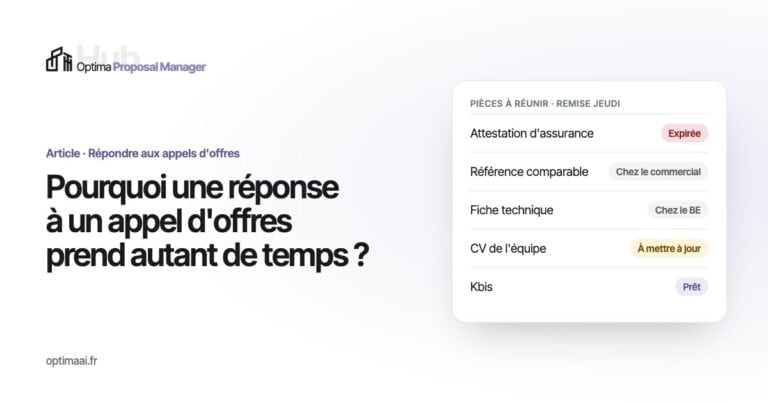
Responding to a tender involves first of all reading: a regulation of the consultation, a technical clauses sheet, annexes, sometimes hundreds of pages. Then you have to write a response that exactly follows what the buyer requests, with evidence. Our article Why does responding to a tender take so much time? details where this time goes, and How to respond to a tender, public or private? describes the overall response.
Generative AI is strong in these two areas: quickly reading a large volume of text and producing a structured first draft. It is weak in what makes a market profitable: real knowledge of your resources, judgment about the market’s interest, and price. The right question is therefore not «Can AI answer for me?» but «At what stage does it save me time without risk?».
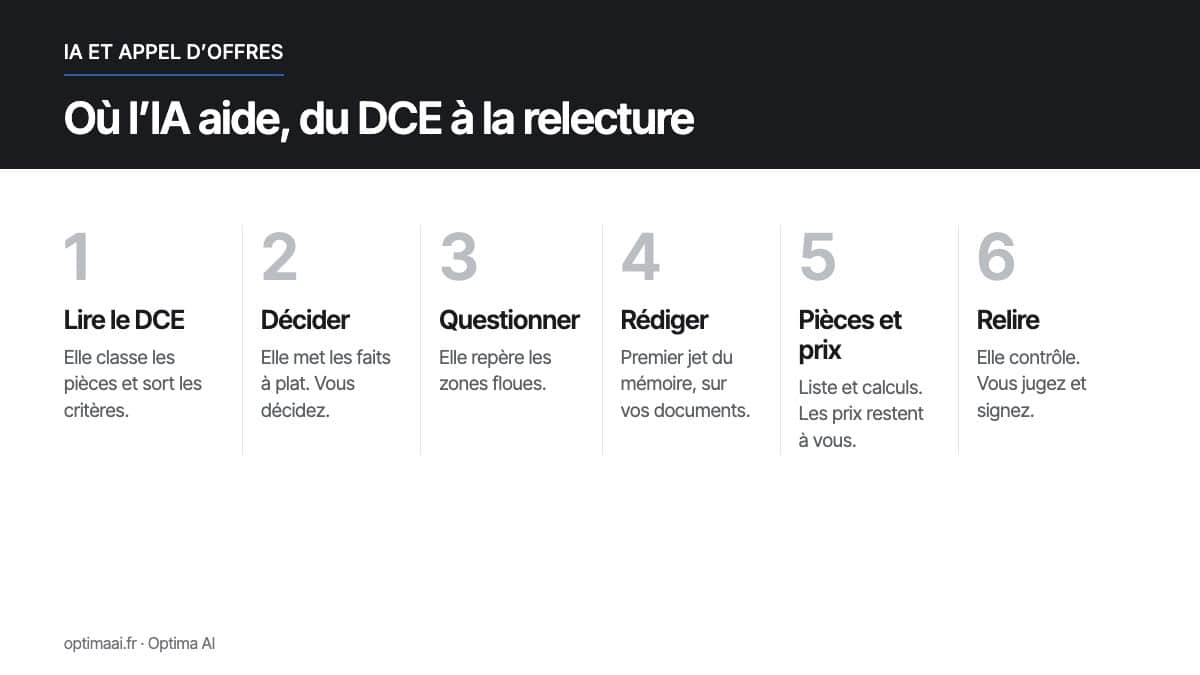
Step 1: Read and classify the DCE
What AI does well. Organize the documents consulted (regulations, clauses sheets, purchase orders, annexes), highlight those that she did not manage to identify, and in a few lines list the subject of the contract, the lots, the dates, the mandatory visits, the documents requested and the criteria for judging.
What she does hurts. See what is missing in the document itself, or a contradiction between two parts that she did not put side by side. A summary is just a summary: the clauses that bind (penalties, deadlines, execution conditions) are repeated in the original text.
What remains to you. Check the dates and elimination requirements in the consultation regulations. The complete method is in our article How to analyse a tender dossier (DCE) before deciding whether to bid?
Step 2: Decide to go
What AI does well. Summarizing what is stated and what is required so that the decision is based on facts: the criteria and their relative importance, the references and certificates requested, the timeline.
What she does hurts. Everything that is not included in the file: your load plan, your relationship with the buyer, the local competition, the margin you are aiming for.
What remains to you. The decision. The criteria for awarding the contract and the procedures for doing so are set out in the documents of each tender (Article R2152-11 of the Public Procurement Code): it is on these criteria and on your actual ability to meet them that the choice will be decided.
Step 3: Prepare your questions for the buyer
What AI does well. Identifying unclear areas: an absence of information in the contract document, an ambiguous technical requirement, and inconsistencies between the terms of the contract and the regulations. She can propose a neutral and precise formulation of the question.
What she does hurts. Knowing whether the question is worth asking, and what it reveals about your offer.
What remains to you. To ask the question using the means and within the time limits set by the consultation regulations.
Step 4: Write the technical report
With the DCE reading, it is the stage where AI saves the most time and where it poses the greatest risk. It prepares a first draft that follows the plan imposed by the criteria, based on your documents: human and material resources, methodology, references, past memories. The risk: a generic text, or worse, a means, a certification or a reference that you do not have. The buyer notes a response tailored to their needs, with evidence; they quickly identifies a text that could be useful in any market.
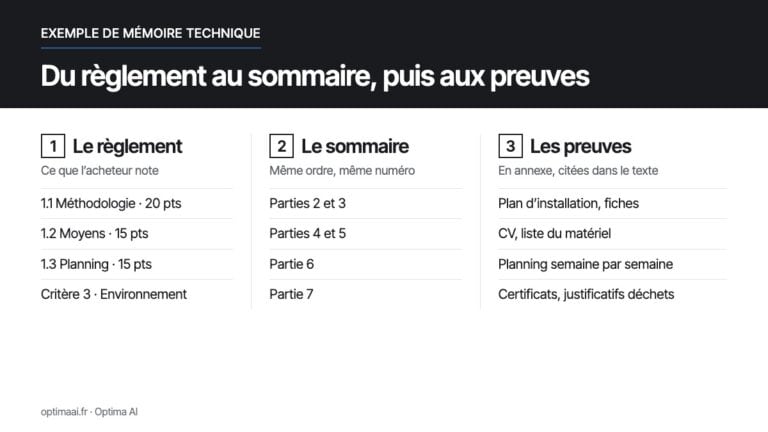
What the buyer really notes is detailed in Method statement: what does the buyer actually score?, and an example commented on in part by Example of technical memory BTP.
Step 5: Assemble the parts and encrypt them
What AI does well. Compile the list of requested documents and check that they are all there: DC1 and DC2 forms or DUME, certificates, memory, price list. Pre-fill the forms based on the company’s information. Calculate a price list once the unit prices have been entered.
What she does hurts. Set a price. A price depends on your costs, workload, and strategy, which the case file does not contain.
What remains to you. Prices and the completeness of the file: an offer that does not meet the requirements of the consultation documents, particularly because it is incomplete, is irregular (Article L2152-2 of the Public Procurement Code). The details of the administrative documents are set out in DC1, DC2, DUME: which administrative documents are needed to respond to a tender?
Step 6: Read over before submitting
What AI does well. Ensure that each criterion has its own answer, that the number of pages is respected, that the names of the market, the buyer and the lot are correct everywhere, and that the mentioned annexes exist.
What she does hurts. Judging whether the answer is convincing. A second reading by someone who knows the project or the service remains indispensable.
What remains to you. Checking each commitment: What you write down can become a commitment in the market: check the list of contractual documents in the special administrative clauses (CCAP) file.
| Step | AI assistance | What remains for you |
|---|---|---|
| Read and classify the DCE | Strong | Re-read the clauses that commit |
| Deciding to go there | Average: she puts the facts in perspective | The decision |
| Questions to the buyer | Average: it identifies the blurred areas | Choosing and asking questions |
| Technical specification | Strong, on your documents | Check every means and every evidence |
| Parts and pricing | Strong on the list and the calculations | The prices |
| Reviewing | Strong on controls | Judging whether the answer is convincing |
Can ChatGPT be used for a tender?
Yes, for specific tasks: restating a paragraph, summarizing a public piece of work, preparing a list of questions. Two limitations quickly become apparent. A general assistant does not know your resources, your references, or your past work: you have to give him everything again for each dossier, and he fills in the gaps with generic text. And the documents you add to it come from outside the company: before you put any DCE documents or your own documents in there, check what the consultation regulations stipulate regarding their confidentiality, and what the provider does with the data entered. Our article Which AI should be used in a company? Compare the tool families.
Mistakes to avoid with AI in a tender
- Letting AI invent a reference or a means. It is the fault that costs the most: it involves the company.
- Submit a generic memo, which could be used for any market.
- Trusting the DCE summary for dates, penalties and eliminatory requirements.
- Starting from scratch for each dossier, Instead of capitalizing on your past responses.
- Forget who is rereading it. A first jet is not an offer.
Software for the analysis of DCE, memory and decoding
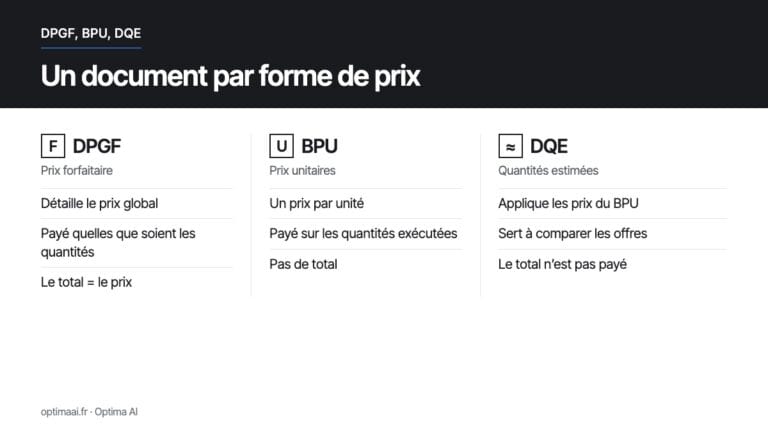
Optima Proposal Manager is our software for responding to tenders, public and private, that you use yourself. It analyses the DCE: it sorts the documents, signals those it has not been able to sort and outputs the criteria for judgment, so that you can decide to go ahead. It writes the technical report with you, either jointly or by lot, based on your documents submitted once and your past responses. For the calculation of the DPGF, you enter your prices; the calculations are done independently and your prices are kept for subsequent responses. It exports the report, the calculation and the DC1 and DC2 forms.
It does not put the file back in your hands, it does not set your prices, it does not decide to go ahead and it will not win you the market. The tool prepares; you read it, you correct it, you validate it. It is revealed to you through a demonstration, on a file close to yours.
Frequently asked questions
Can AI respond to a tender on my behalf?
No. She can read the dossier, review the criteria and prepare a first draft of the report based on your documents. The decision to proceed, the prices, the verification of each commitment and the signature remain the responsibility of the company that responds.
Is it legal to use AI to respond to a tender?
The articles of the Public Procurement Code mentioned in this article concern the submitted offer, not the way it is prepared. The company remains responsible for what it submits: an incomplete offer or one that does not comply with the consultation documents is irregular (Article L2152-2 of the Public Procurement Code). Also check what the regulation of the consultation says about the confidentiality of the documents.
Can the buyer know that a response was written using AI?
He mainly looks at whether the answer is generic. A report that cites the site’s constraints, the resources actually allocated, and verifiable references stands out, regardless of whether it was prepared with or without AI.
At what stage does AI save the most time?
When reading the DCE and the first draft of the technical report, she works from your own documents. This is also where the re-reading counts the most.
 French
 English