
By Mathieu Domon, President of Optima AI · Updated on November 17, 2026
The DPGF, or Decomposition of the Total and Fixed Price, is the table in which a company details, item by item, the fixed price it offers for a given market, most often a works contract. The buyer provides the framework in the consultation dossier; the company enters its quantities, unit prices, and totals. When completed correctly, it makes the offer readable and comparable; when incomplete, it can render the offer irregular or lead the company to a price it has not actually calculated. The main point to remember: in a fixed-price market subject to the CCAG for works, a discrepancy between the quantities of the DPGF and those actually executed does not change the price paid. It is before submission that these discrepancies must be checked.
In short
- The Public Procurement Code distinguishes between two forms of price: unit prices, «applied to the quantities actually delivered or performed», and flat-rate prices, «regardless of the quantities delivered or performed» (article R2112-6). In practice, the DPGF details a flat-rate price; the BPU and the DQE are used for unit prices.
- In a market that refers to the General Administrative Conditions of the Works Contracts (CCAG works of 2021), the discrepancies between the quantities of the breakdown and the quantities actually executed «cannot lead to a change in that price», nor can errors in the breakdown (article 10.3.1).
- An incomplete offer is irregular (Article L2152-2 of the Code).
What is a DPGF in a public market?
The DPGF is the decomposition of the overall and lump-sum price. It breaks down the total price of a work or service into individual items: site installation, groundwork, masonry, joinery, painting, cleaning. For each item, a unit (m², ml, unit, package), a quantity, a unit price and a total; at the bottom, the total excluding taxes, VAT and the total including all taxes.
The acronym does not appear in the Public Procurement Code. It comes from the practice of works contracts, and the CCAG travaux describes its content: the breakdown of a flat-rate price is presented «in the form of an evaluation detail comprising, for each type of work or each element of work, the quantity to be executed and the unit price corresponding to it» (article 9.3.2).
It is found in the file containing the consultation documents (DCE), most often in a spreadsheet, next to the commitment act, the consultation regulations, the CCAP and the CCTP. The framework is set by the buyer or their project manager: the company fills it out; it does not reorganize it.
DPGF, BPU, DQE: what difference does it make?
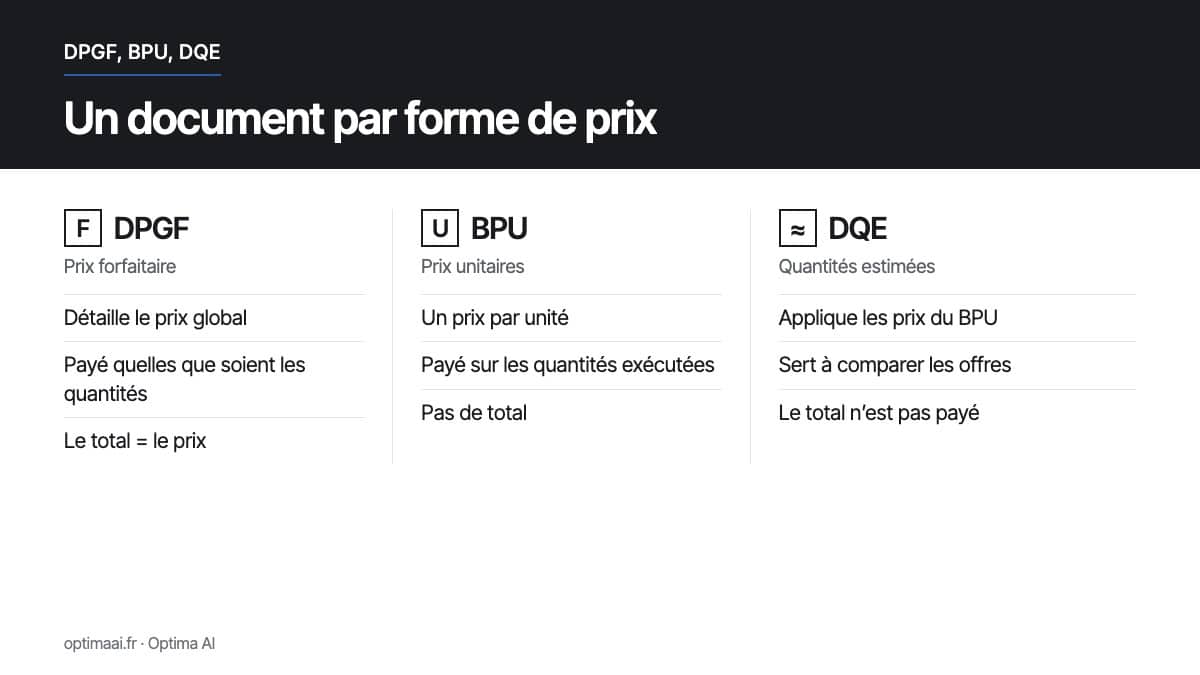
The three documents list an offer, but not for the same price form.
- Bill of Quantities For one Fixed price. The total amount is the market price; the quantities and unit prices explain how it was constructed.
- BPU (unit price sheet): for units unit prices. It lists a price per unit, without a total: the company will be paid for the quantities actually executed.
- DQE (quantitative estimate detail): it accompanies the BPU. The buyer enters estimated quantities, the company transfers its BPU prices to it, and the total serves to compare the offers. This total is not the price paid.
The CCAG travaux defines two forms of pricing: the price is fixed, which remunerates «a work, a part of a work or a determined set of services defined by the contract» and is mentioned as fixed; or the price applies only to a set of services that is not likely to be repeated; all other prices are unit prices (article 9.2). The same contract can combine both: a fixed price for the main work, unit prices for works whose quantity is uncertain. This is stated in the CCAP and the regulations for the consultation.
Is the DPGF part of the contract?
It depends on the parts of the market. In the 2021 CCAG works, «the elements of the breakdown of the financial offer of the holder» are listed among the contract parts, but among the last in order of priority, after the commitment act and its financial annexes, the CCAP and the CCTP (article 4.1), unless the market derogates from it: in that case, it indicates the articles of the CCAG that it derogates from (article R2112-3 of the Code). Therefore, check in the CCAP where it is placed: when the DPGF is attached to the commitment act as a financial annex, it takes first place with it.
Contractual or not, the decomposition does not change the nature of the package. The CCAG travaux is explicit: the discrepancies between the quantities actually executed and those indicated in the decomposition «even if this has contractual value, cannot lead to a change in this price. The same applies to the errors that this decomposition could contain» (article 10.3.1).
The DPGF nevertheless plays a role during the construction: it is used to calculate the advance payments when a work is not complete (article 12.1.3) and its unit prices serve as a basis for fixing new prices in the event of modification work (article 13.3). A poorly calculated unit price therefore follows you through to the final calculation.
How to fill out a DPGF, step by step?
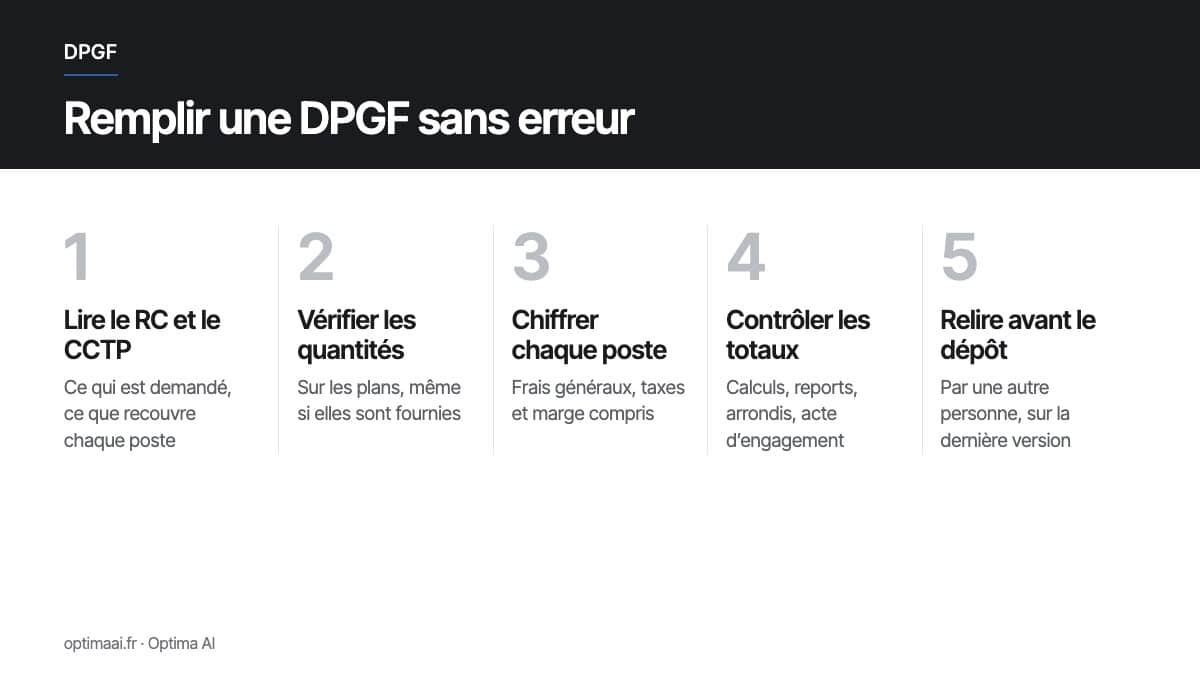
1. Read the consultation rules and the CCTP before opening the spreadsheet
The regulations of the consultation state whether the DPGF must be submitted with the offer, whether quantities are given by the buyer or determined by the company, and how the buyer handles any discrepancies between the DPGF and the commitment document. The CCTP, on the other hand, describes what each item covers. A line of DPGF is always read in conjunction with the CCTP article that corresponds to it. For a complete method of reading the file, see How to analyze a DCE before deciding to respond.
2. Check the quantities, even when they are provided
This is the step that is most often skipped. In a flat-rate market, if the DPGF indicates 420 m² of paint and the plans show 465, you will be paid for the flat-rate, not for 465 m². Recheck the measurements on the plans. In case of discrepancy, ask the buyer during the consultation, via the platform and within the timeframe set by the consultation rules, and follow their response.
3. Calculate each item with everything it includes
The prices for CCAG works «are deemed to include all expenses resulting from the execution of the works and services, including overheads, taxes and duties,» as well as the margin, and to take into account normally foreseeable conditions (article 9.1.1). A service described in the CCTP but omitted from your quote is not paid extra: it is deemed included in the package. Think of the items that are forgotten: installation and dismantling of the worksite, protective measures, waste disposal, cleaning, tests, and final works documents.
4. Control totals, subtractions and rounding
Check each multiplication quantity × unit price, each subtotal of the chapter and the report of the total of the DPGF in the commitment document. A cell overwritten by a value or a line added outside the sum is enough to create a discrepancy.
5. Read again with a fresh perspective before filing
Have someone who has not done the calculations read it over. They will spot the empty lines, the «0»s left out by default, the mis-typed units (ml instead of m²) and inconsistent prices from lot to lot. They will also check that the DPGF submitted is indeed the one from the DCE, in its latest version if the buyer has changed it during the consultation.
What DPGF errors can disqualify an offer?
An empty line or a missing document. An irregular bid is an offer that «does not comply with the requirements set out in the documents of the consultation, in particular because it is incomplete» (article L2152-2). In negotiated procedures and calls for tenders, irregular bids are eliminated (article R2152-1). The buyer «may» authorize all the interested bidders to regularize them, provided that they are not abnormally low, and without modifying their substantive characteristics (article R2152-2). This is a facultative right: do not count on it. In other procedures, particularly those with negotiation, irregular bids «may become regular or acceptable during the negotiation or dialogue, provided that they are not abnormally low» (article R2152-1).
An abnormally low price. An abnormally low offer is an offer «whose price is manifestly undervalued and is liable to compromise the proper execution of the market» (article L2152-5). When an offer appears abnormally low, the buyer requires the company to «provide details and justifications regarding the amount of its offer» (article L2152-6); article R2152-3 lists those that it may take into account; it rejects the offer if they do not «satisfactorily justify the low level of the price or costs proposed» (article R2152-4). A figure quoted at zero or very close to others may be sufficient to trigger the request for details, but it is the overall offer that is judged.
This total does not correspond to the commitment document. The settlement of the consultation generally states which of the two amounts the buyer retains, or whether he requests confirmation. Once the contract is signed, the commitment deed and its financial annexes take precedence over the other documents (CCAG works, article 4.1), unless otherwise provided by the CCAP. It is better for both amounts to be identical to the cent.
A modified framework. Deleting a line, merging two lines, or adding a reservation in a cell: the offer no longer complies with the imposed framework. If a position seems to be missing or poorly described, ask the question during the consultation rather than correcting the table yourself.
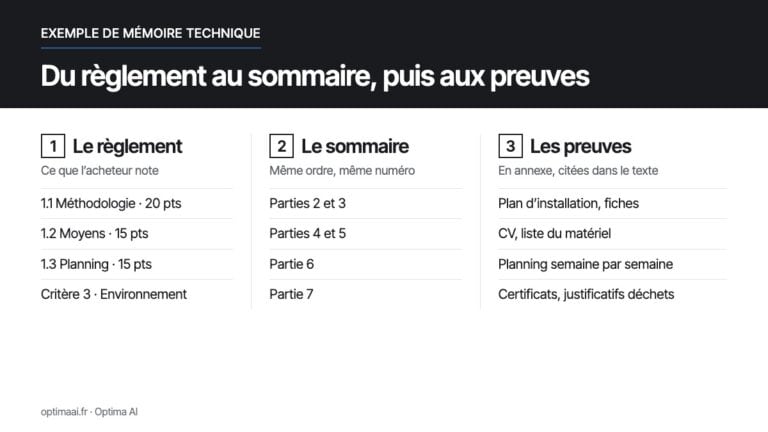
The DPGF is just one of the elements of the offer: the technical report is also noted, according to the criteria announced in the consultation regulations. See What the buyer really notes in a technical memo and, for the entire process, How to respond to a tender, whether public or private.
Prepare the DPGF with the rest of the offer
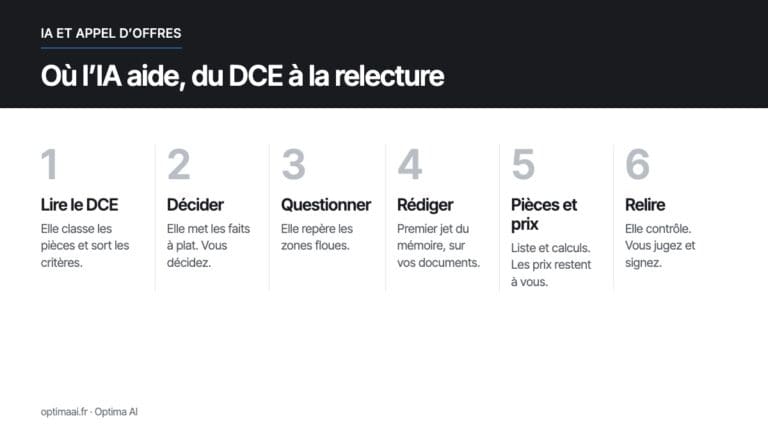
The DPGF and the technical report describe the same functionalities: they are prepared together, based on the same reading of the DCE. Optima Proposal Manager Optima AI’s software for responding to tenders, public and private, that you use yourself. It analyses the DCE, writes the technical report with you, and for the calculation of the DPGF, you enter your prices; the calculations are done automatically, and your prices are kept for subsequent responses. The prices remain yours: the software does not set them on your behalf, and the decision to respond remains yours. It is available for demonstration on a file similar to yours. The file you submit remains the DCE’s DPGF model: the ten controls above apply.
Frequently asked questions
What does DPGF mean?
DPGF means «dissolution of the overall and lump-sum price». This is the table that details, item by item, an overall price proposed in a tender, most often for works. The acronym comes from the practice of public procurement and is not included in the Public Procurement Code.
Who writes the DPGF: the buyer or the company?
Both. The buyer, or their project manager, sets the framework in the DCE: positions, units, sometimes quantities. The company then sets its unit prices, amounts, and, if the consultation agreement so requires, its quantities.
Can the quantities of a DPGF be modified?
Only if the consultation settlement so provides. Otherwise, the company keeps the framework and reports the discrepancy to the buyer during the consultation.
What happens if I forget a post in the DPGF?
If a planned line remains empty, the offer may be considered incomplete, therefore irregular (article L2152-2). If the service is described in the CCTP but does not have a line in the DPGF, it is in principle included in your flat-rate price: in the CCAG works, prices cover all expenses and foreseeable circumstances (article 9.1.1). Ask the buyer during the consultation.
Sources
- Public procurement code, articles R2112-2, R2112-3 (general documents) and R2112-5 to R2112-9, including R2112-6 (form of prices) (Legifrance)
- Public procurement code, articles L2152-1 to L2152-9, including L2152-2 (irregular tenders), L2152-5 and L2152-6 (abnormally low tenders) (Legifrance)
- Public procurement code, articles R2152-1 to R2152-13, including R2152-1, R2152-2, R2152-3 and R2152-4 (Legifrance)
- Decree of 30 March 2021 approving the General Administrative Clauses Sheet of the Public Works Procurement (CCAG travaux) Articles 4.1, 9.1.1, 9.2, 9.3.2, 10.3.1, 12.1.3, 13.3 (Légifrance)
 French
 English