
By Mathieu Domon, President of Optima AI · Updated October 27, 2026
A good example of technical memory is not recopied: it shows how each recorded part meets a sub-criterion of the consultation rules, with supporting evidence. Here is a complete example, written for a fictitious set of works and commented on in detail: what each passage brings to the buyer, and what you need to replace with your own means.
In short
- The example concerns a fictitious market: the set of interior joinery for a renovated school without closing down. Everything in brackets needs to be replaced.
- Its summary recapitulates the criteria and sub-criteria of the consultation regulation, in the same order.
- Each part contains at least one piece of evidence: a name, a quantity, a date, a document attached.
- For consultations initiated since August 21, 2026, at least one attribution criterion takes into account the environmental characteristics of the offer (article L2152-7 of the Public Procurement Code).
What can an example of technical memory teach you?
The outlines found online provide a list of titles: company presentation, means, methodology, planning. Useful for not forgetting anything, but a list of titles does not show what is written below. An example drafted shows the level of detail expected: names of people rather than a headcount, dated steps rather than a promise, documents attached rather than an affirmation.
Its limit: no example is valid in isolation. The criteria for awarding contracts and the procedures for implementing them are set out in the documents of each tender (Article R2152-11 of the Public Procurement Code), and an offer that does not meet the requirements of these documents, especially because it is incomplete, is irregular (Article L2152-2). What the buyer notes is detailed in our article Method statement: what does the buyer actually score? Here we move on to the practical part.
Which market does our example apply to?
At an invented consultation for the occasion, here is an excerpt from the regulations.
| Rules of the consultation (fictitious extract) | Weight |
|---|---|
| Subject Renovation of elementary school [name], lot 4 «Interior wood joinery». Work on site, in phases. | — |
| Criterion 1 · Technical value, appreciated on the technical report (maximum 20 pages, excluding annexes) | 50 % |
| 1.1 Methodology and organization of the construction site on-site | 20 points |
| 1.2 Human and material resources allocated to the lot | 15 points |
| 1.3 Detailed planning and respect for the phases | 15 points |
| Criterion 2 · Price | 40 % |
| Criterion 3 · Environmental performance Waste management and wood origin | 10 % |
In formalized procedures, the criteria are weighted or, if this is not possible for objective reasons, ranked in descending order of importance (article R2152-12). This weight determines where to focus your efforts: here, the methodology will be the most developed part.
How to build the summary based on the regulation?
In reverse: we start with the sub-criteria, we match one or more of them to each, and then the supporting evidence. A summary and a section on understanding the need may precede them: they are not numbered separately, but they prepare the answer for the most difficult sub-criterion.
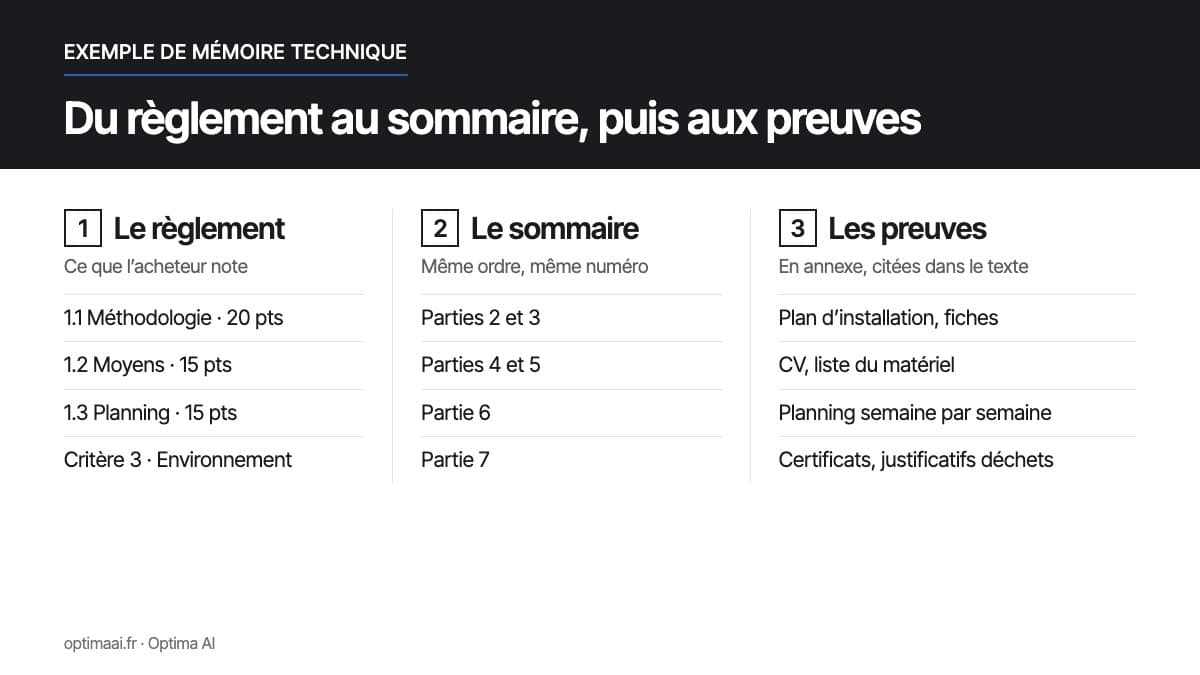
Two rules: the same order as the regulation, and the number of the sub-criterion mentioned in each title, as in the summary of the example below. If the regulation imposes a response framework, that framework forms the summary.
The example of technical memory commented on, part by part
The text of the captions is the example; the commentary explains why it is written that way.
Guard page and summary
Technical memory — [Your company]
Renovation of the elementary school [name] · Lot 4: Interior wood joinery · Consultation no. [reference] · [date]Summary 1. Summary of our commitments · 2. Understanding the need · 3. Methodology and organization in the field (sub-criterion 1.1) · 4. Human resources assigned to the lot (1.2) · 5. Material resources assigned to the lot (1.2) · 6. Planning and phasing (1.3) · 7. Environmental performance (criterion 3) · Annexes
The comment. The item, lot and reference are written exactly as in the regulations: the evaluator knows that he is holding the correct document. The number of the sub-criterion next to each title serves as a reference for him to fill in his grid.
1. Summary of our commitments
In Lot 4, [Your company] commits to:
- assign a single site manager, [First Name Last Name], present at every phase of installation;
- not carry out any noisy activities during class hours [CCTP slots];
- close each work area and separate it from the student traffic before starting up;
- manufacture the gate blocks in the workshop, so that only the laying and installation are carried out on site;
- sort the waste on site and return the proof of collection at each stage.
The comment. One page, five verifiable commitments during the construction phase, each developed in more detail later on. It provides an overview before going into detail.
To be adapted. Only include what you will keep: the memorandum can become a piece of the market. Check the list of contract documents in the special administrative clauses (CCAP) booklet.
2. Understanding the need
Lot 4 concerns the replacement of [number] door panels and the installation of [number] metres of cabinets in a school that remains open. We have identified three constraints from the CCTP and the timetable for the operation:
- the presence of students and staff, which imposes closed areas and schedules;
- the sequence with lot 2 (partitions), which is completed in each zone before our installation, and lot 6 (paint), which comes after ours;
- the fire-prevention doors of the circulation areas, whose fire classification reports are attached as Annex 7 [if the CCTP so provides];
- the asbestos detection results before work attached to the consultation dossier [elements concerned in the works to be submitted, or absence of asbestos detected], which condition the method of disposal and the waste disposal.
Point of attention: [question asked to the buyer during the consultation, and answer obtained].
The comment. This part does not replicate the specifications: it proves that they were read. The constraints adopted are those that change the way of working, and each one finds its answer in the following part.
To be adapted. Your constraints come from your file. The method to overcome them: How to analyse a tender dossier (DCE) before deciding whether to bid?
3. Methodology and organization in the field (sub-criterion 1.1)
Before starting. Site visit with the school management and the design team; measurement of the dimensions of each bay; site installation plan submitted for validation (Annex 2).
For each phase. Closure of the area by temporary partitions and signage; removal of the old door blocks [day without class or authorized slot], according to the results of the asbestos survey (part 2); evacuation by [delivery access], without crossing the courtyard; installation of door blocks manufactured in the workshop (technical specifications in annex 7); door inspection by door on a receipt form (annex 3); cleaning and reopening of the area before the return of students [the day before the start of the school year for the holiday phases, the same evening for the phases during the school year].
Interlocutors. One contact point for the school, the site manager; a written report after each site meeting.
Security. [Marking of the areas, keeping students away from the work areas, closed storage of tools and lockable gates pending], included in our safety plan for this construction site.
The comment. The most demanding sub-criterion, the most developed part. The text follows the order of the project, each step corresponds to a constraint of Part 2, and the attached annexes are evidence that the evaluator can note.
4. Human resources allocated to the lot (sub-criterion 1.2)
Role No one Useful experience Presence Construction worker [First name Last name] [number] construction sites occupied Meetings, receptions Chief of construction site [First name Last name] [qualifications, authorizations] Permanent during the pose Installation team [number] carpenters installers [Qualifications] According to the phasing Workshop [number] carpenters Production of gate blocks Before each phase In the event of the absence of the project manager, [First Name Last Name], [Function], he/she will replace him/her; the design and construction company will be informed in writing. CV attached as Annex 1.
The comment. The people affected by this lot, not the company’s workforce. The planned replacement answers a question that the evaluator asks without writing it down.
To be adapted. Only include people who are present on the scheduling dates.
5. Material resources allocated to the lot (sub-criterion 1.2)
In the workshop [machines used for manufacturing]. On the website [number] installed positioning positions; construction vacuum cleaner adapted to wood dust; handling cart for the door blocks. Delivery : one per phase, per [access].
The comment. Each piece of equipment is linked to a site constraint: the aspiration system for dust in a school, the cart so as not to carry doors in the corridors. The company’s entire fleet would not say anything about this lot.
6. Planning and phasing (sub-criterion 1.3)
Phase Zone Period Compromised 1 Building A, ground floor [Autumn holidays] School closed: filing and installation 2 Building A, floor [weeks X to Y] Noisy operations outside class hours 3 Building B [winter holidays] After the end of lot 2 in the zone Reception All buildings [date] Withdrawal of reservations under [number] days The detailed schedule, week by week, is included in Appendix 4. It includes the dates of the operational forecast calendar.
The comment. The phasing follows the school calendar and the dependencies announced in part 2. The part shows the logic, the annex details it.
To be adapted. Your schedule should never contradict the deadline for the commitment act.
7. Environmental performance (criterion 3)
Waste sorting on site (wood, metals, plaster, packaging, non-hazardous waste in mixed form); any potentially hazardous waste [lead paint, asbestos elements] treated separately, according to the location; disposal to [treatment facility, city]; supporting documentation of the handling provided to the design and construction team at each stage (model in annex 5). Wood : from sustainably managed forests, certificates from suppliers attached to Annex 6. Transport : a batch delivery from the workshop located at [distance].
The comment. A distinct criterion calls for a distinct part, even if short. For the consultations launched since August 21, 2026, at least one attribution criterion takes into account the environment (Articles L2152-7 and R2152-7 of the Public Procurement Code): when this criterion is assessed on the file, describe the measures taken on this lot, proven by documents, not the company’s general policy.
Appendices
1: CV of the works manager and site manager · 2: site installation plan · 3: model of receipt form · 4: detailed schedule · 5: model of proof of waste collection · 6: certificates of origin for the timber · 7: technical sheets and fire classification reports for the gate blocks
The comment. Each annex is cited in a section: an annex that goes unmentioned risks not being read. Check whether the regulations include the annexes in the number of pages. The references to comparable projects, on the other hand, are requested according to the consultations with the candidate, in the report, or both (see DC1, DC2, DUME: which administrative departments?).
How can this example be adapted to another profession?
The structure remains; the content of each part changes.
| Part | Formation | Cleanliness | Information Technology |
|---|---|---|---|
| Understanding the need | Public, entry level, objectives | Surfaces, occupancy times | Technical environment, users |
| Methodology | Pedagogical process, evaluation | Range of interventions by zone, controls | Project method, recipe |
| Human resources | Appointed trainers | Managers, agents, replacements | Project manager, affected profiles |
| Planning | Calendar of sessions | Passage frequencies | Delivery milestones |
| Environment | Travel, supports | Products, water consumption | Equipment, travel |
What mistakes lead to losing points when starting from an example?
- Keep the example plan Instead of the one in the regulation: the evaluator looks for his sub-criteria without finding them.
- Leaving the name of another buyer or another lot : Copying and pasting is seen, and that makes the rest of it questionable.
- Describing the company rather than the lot Total workforce, complete fleet, turnover.
- Exceeding the number of pages imposed.
- Contradicting another item in the offer : a different time limit for the commitment act, a different amount for the price list.
How do you transfer this example to your own memory?
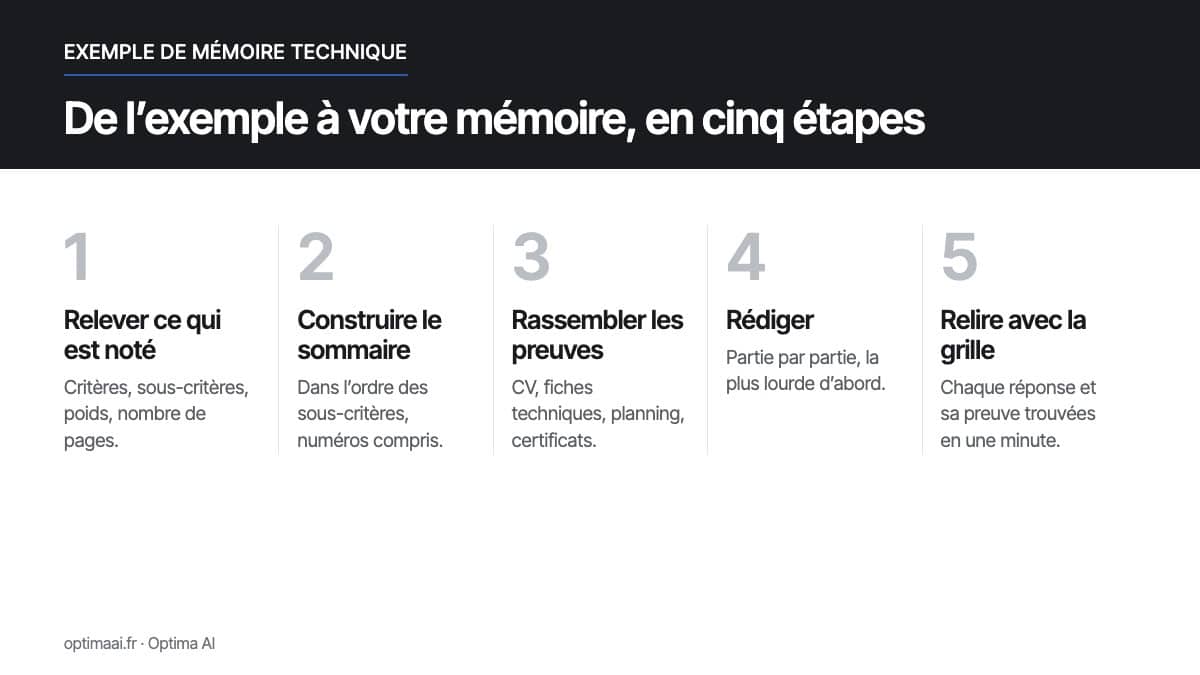
- Highlighting what is noted in the regulation: criteria, sub-criteria, weight, number of pages, possible response framework.
- Construct the summary in the order of the sub-criteria, with their number in each title.
- Gathering evidence before writing CVs, certificates, technical sheets, schedules, certificates. What you cannot prove, do not write down.
- Writing paragraph by paragraph, Starting with the sub-criterion that weighs the most.
- Reading again with the grid For each sub-criterion, can you find the answer and the proof in less than a minute? Otherwise, go back and check it in the main part of the document.
To download: the self-revision grid
Refer to the criteria in your regulation, then check for each where you answer them and with what evidence: a Word template, with this example already filled in.
And for your next case: starting from the criteria of judgment
In this example, everything starts from the criteria of the regulation. That’s also where it begins. Optima Proposal Manager, Our software for responding to public and private tenders. You submit the consultation dossier: it sorts the documents, flags those it hasn’t been able to sort and comes up with the judging criteria.
He then writes the technical report together with you, either as a collective or by lot, based on your documents submitted once and your past responses. The tool prepares; you read it again, you correct it, you validate it. It does not return the file to you in your place and it will not win you the contract. Optima Proposal Manager is demonstrated on a file similar to yours.
Frequently asked questions
Where can I find an example of technical documentation in PDF format?
This page is one of them: the tables form a complete technical report for a set of windows in use, to be copied into your word processor and adapted to the regulations of your consultation. The PDF examples circulating online were written for other markets: use them to see the level of detail, never for the plan or the text, because the plan comes from the regulations.
Can a free technical memory model be used as is?
No. A model provides a starting point, not an answer: the summary must follow the criteria of the regulations for each consultation, and each party must describe the actual resources allocated to the market.
What is the difference between a framework, a model, and an example of technical memory?
A framework is a list of titles. A model is a document to be completed, with its sections. An example is a written essay, which shows the level of detail expected. None of these replaces reading the regulations.
How many pages should a technical report in the BTP contain?
There is no standard length. Some regulations set a maximum number of pages, sometimes without appendices: respect that. Otherwise, aim for what is necessary to meet each sub-criterion with evidence, and include the details in an appendix.
How to write a technical paper for the first time?
Start with the regulations, not a model: identify the criteria, build the outline in that order, gather your evidence, and then write. Our article How to respond to a tender, public or private? replace the memory with the entire answer.
Sources
- Public procurement code, articles L2152-1 to L2152-9 (irregular tenders; criteria for award, including L2152-7) (Legifrance)
- Public procurement code, Article R2152-7 (choice of award criteria) (Legifrance)
- Public procurement code, article R2152-11 (criteria indicated in the consultation documents) (Legifrance)
- Public procurement code, article R2152-12 (weighting or ranking of criteria) (Legifrance)
 French
 English